9 Questions to Ask Before Signing Any Business Loan
Don't sign until you know the real cost. Nine plain-English questions to ask any lender, and what a good answer looks like.
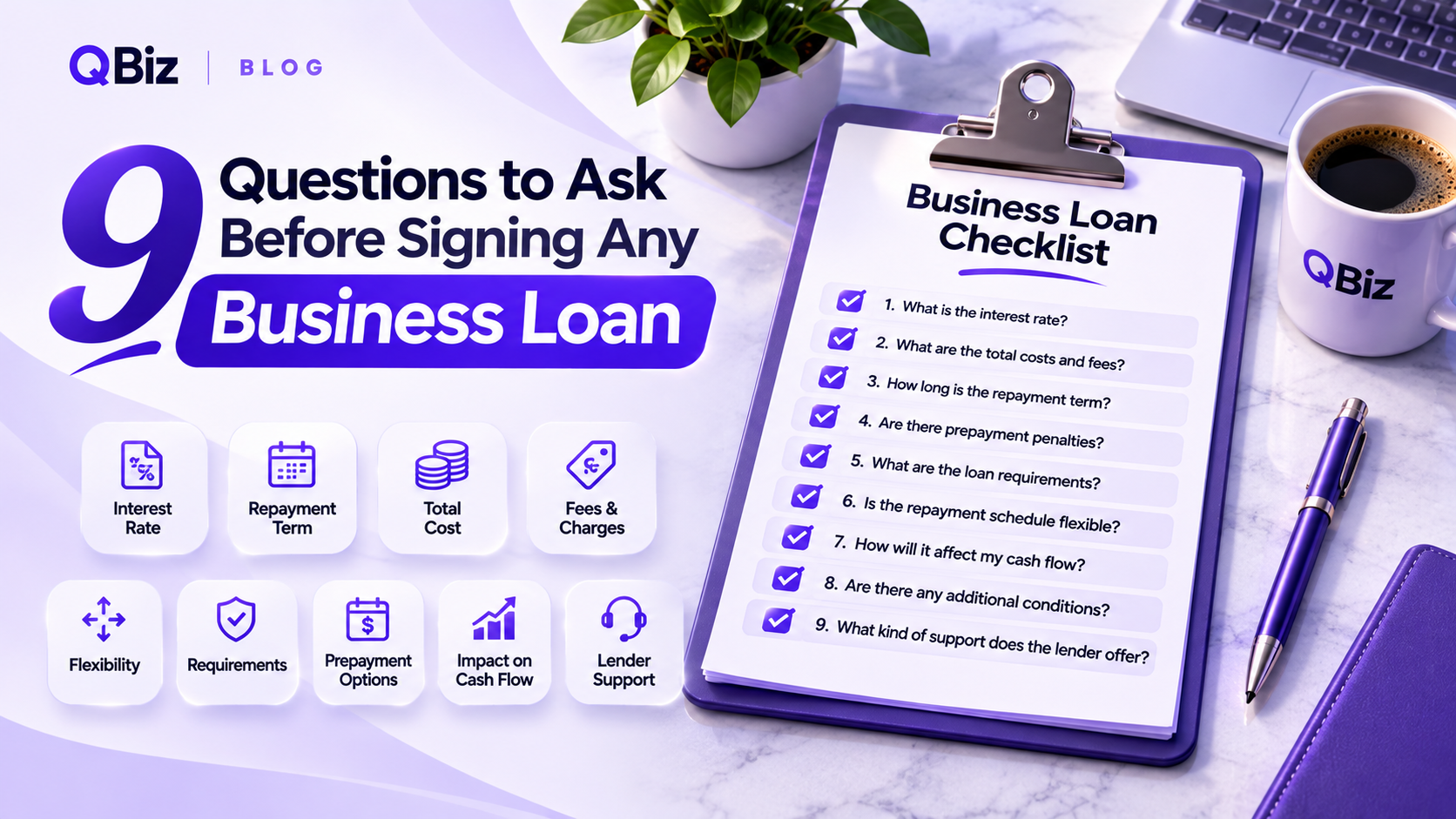
9 Questions to Ask Before Signing Any Business Loan
Short answer: before you sign a business loan, ask what the total cost is, what fees apply, how often payments are due, whether you can repay early without a penalty, what collateral or personal guarantee is required, how fast you’ll be funded, whether the loan type fits your need, and what happens if you can’t make a payment. Get every answer in writing.
A loan can help your business grow, or quietly drain your cash flow. These are the questions to ask before signing a business loan, in plain English, with what a good answer looks like.
1. What Is the Total Cost of This Loan?
Don’t stop at the rate. Ask for the total amount you’ll repay over the full term, and compare that number against the amount you borrow.
Pay attention to how the cost is stated. Many loans use an annual percentage rate (APR), which includes interest and certain fees. Others, such as merchant cash advances, use a factor rate, which can look smaller but isn’t directly comparable to an APR. If a lender quotes only one, ask for the total repayment amount so you can compare fairly.
2. What Fees Are Included?
Fees can change the real price of a loan. Ask about origination or application fees, closing costs, late payment fees, and any fee for changing or extending the loan.
Then ask whether those fees are taken out of the amount you receive. If they are, you’ll get less than you borrowed but repay the full amount.
3. How Much Is Each Payment, and How Often Is It Due?
Monthly, weekly, and daily payments affect your cash flow in very different ways. A daily or weekly schedule can feel heavy for a business with uneven income, even if the total cost looks reasonable.
Work out whether your normal sales can cover each payment comfortably, including in your slowest month. If you want help seeing that picture, start with our guide on how to track cash flow without hiring a CFO.
4. Is There a Prepayment Penalty?
Ask whether you’ll pay extra if you repay early. Some loans charge a fee for paying off early, and others don’t. On certain products you may still owe the full cost even if you pay sooner.
If your business might have a strong year, you’ll want to know whether paying down the loan early saves you money or costs you.
5. Is Collateral Required?
Collateral is an asset the lender can claim if you can’t repay, such as equipment, inventory, or property. Ask exactly what’s being pledged, how it’s valued, and what happens to it if you fall behind.
Some loans are unsecured and others are secured. Neither is automatically better, but know which one you’re signing.
6. Will I Need to Sign a Personal Guarantee?
A personal guarantee means you’re personally responsible for the debt if the business can’t pay. It’s common with small business loans, especially for newer companies.
Ask whether one is required, how far it extends, and whether it ends once the loan is repaid. This is a good point to review with an accountant or attorney.
7. How Fast Will I Get the Money, and What Do You Need From Me?
Ask how long approval and funding usually take, and which documents you’ll need, such as bank statements, tax returns, and financial statements.
8. Is This the Right Type of Loan for My Need?
A term loan, a line of credit, equipment financing, invoice financing, and an SBA loan each solve a different problem. Matching the product to the need keeps costs down and makes repayment easier.
If your needs go up and down, a business line of credit may fit better than a lump-sum loan. If you’re buying machinery, equipment financing ties the loan to the asset. And for longer terms and larger amounts, our guide on how to apply for an SBA loan shows what to expect.
9. What Happens If I Can’t Make a Payment?
Ask about grace periods, late fees, whether the lender will work with you on a temporary adjustment, and what counts as a default.
Also ask who you’d contact if something goes wrong. A lender that gives you a clear answer now is usually easier to work with later.
How Can You Compare Loan Offers Side by Side?
Put each offer next to the others and compare the same things: total repayment, fees, payment schedule, prepayment terms, collateral, guarantee, and speed. The cheapest-looking loan isn’t always the best fit. Our guide to small business financing options walks through the product types.
How Does myQBiz.ai Lending Help?
Comparing lenders one at a time means repeating the same paperwork. myQBiz.ai Lending brings nine loan programs into one guided application, so you can see the options side by side. Programs range from $10K to $100M, depending on the program.
You can check your eligibility in about two minutes. It uses a soft credit inquiry, so your credit score isn’t affected, and a hard inquiry only happens if you choose a program and complete a full application. A human loan specialist can walk through your numbers, explain each program, and stay with your application along the way.
Before you borrow, it also helps to know your own numbers. The free AI Business Advisor connects to Stripe, Shopify, and QuickBooks, and answers plain-English questions about your revenue, cash flow, and profit, so you can tell how much payment your business can truly handle.
Key Takeaways
Compare total repayment, not just the rate.
Ask about every fee, and whether it’s taken from the amount you receive.
Check that the payment schedule fits your slowest month.
Know the collateral, personal guarantee, and prepayment terms before signing.
Get every answer in writing, and review the agreement with a professional if you’re unsure.
Frequently Asked Questions
What should I ask before signing a business loan? Ask about the total cost, fees, payment schedule, prepayment penalty, collateral, personal guarantee, funding speed, loan type, and what happens if you miss a payment.
What is the difference between APR and a factor rate? APR expresses the yearly cost of a loan, including interest and certain fees. A factor rate is a fixed multiplier applied to the amount borrowed. Because they’re calculated differently, ask for the total repayment amount to compare them.
What is a personal guarantee on a business loan? It’s a promise that you’ll repay the debt personally if the business can’t. Many small business loans require one, so ask about it before you sign.
Does checking eligibility affect my credit score? Not with myQBiz.ai Lending. Checking eligibility uses a soft credit inquiry, which doesn’t affect your score. A hard inquiry only happens if you choose a program and complete a full application.
Take the Guesswork Out of Your Next Loan
You don’t have to compare loan offers alone. See which programs fit your business, and talk through the terms with a person who can explain them.
Check your eligibility with myQBiz.ai Lending. It takes about two minutes, with no impact on your credit score.