
Business Line of Credit: How It Works and How to Choose One
A clear breakdown of how a business line of credit works, when it makes more sense than a term loan, and what to compare before choosing one.
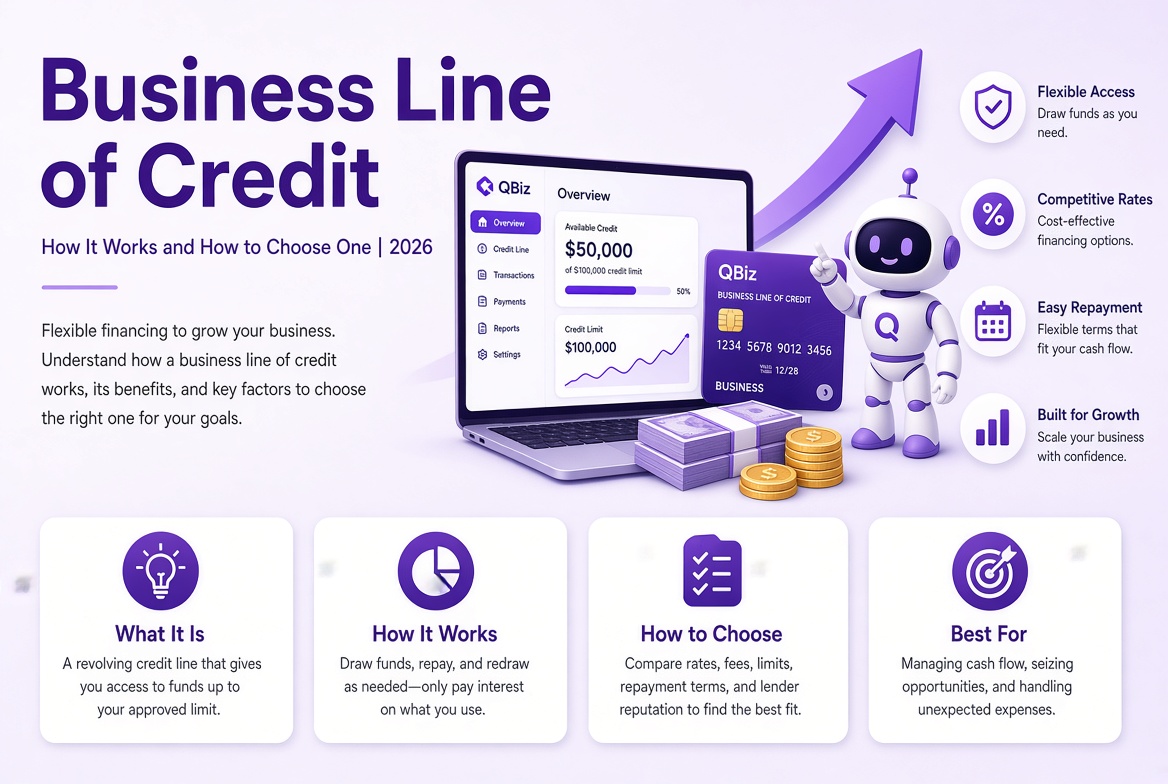
Most financing conversations start with the same question: loan or line of credit? For a lot of businesses, the answer isn’t obvious, mostly because a line of credit gets described in vague terms “flexible funding,” “revolving credit” without anyone explaining what that actually means for how the money moves and what it costs.
Here’s a clear breakdown of how a business line of credit works, when it makes more sense than a term loan, and what to actually compare before choosing one.
What Is a Business Line of Credit?
A business line of credit is a pool of funds a lender approves you for upfront, which you can draw from as needed, repay, and draw from again — similar to how a credit card works, but usually with lower rates and higher limits designed for business use.
The core difference from a traditional loan is simple: with a loan, you receive a lump sum and start repaying it immediately, whether you need all of it right away or not. With a line of credit, you only borrow what you use, and you only pay interest on that amount. If you’re approved for $50,000 and draw $10,000 to cover a slow month, your interest is calculated on that $10,000 — not the full limit sitting untouched.
How Does It Actually Work?
Once approved, the line stays open and available, much like a credit limit. You draw funds when you need them, whether that’s covering payroll during a slow season, buying inventory ahead of a busy quarter, or bridging a gap between an invoice being sent and actually being paid. As you repay what you’ve drawn, that amount becomes available to borrow again — the line “revolves,” which is why it’s often called revolving credit.
Most lines fall into two categories:
• Secured lines of credit — backed by collateral, such as receivables or inventory, which typically comes with lower interest rates and higher limits.
• Unsecured lines of credit — no collateral required, but usually smaller limits and higher rates, since the lender is taking on more risk.
When a Line of Credit Makes More Sense Than a Loan
A line of credit tends to fit situations where the need for cash is ongoing or unpredictable, rather than a single, defined expense. A few common scenarios:
• Managing seasonal cash flow. A retailer that makes most of its revenue in Q4 can draw on a line during slower months and repay it once revenue picks back up.
• Bridging the gap between invoicing and getting paid. If your customers pay net-30 or net-60, a line of credit can cover payroll and operating costs while you wait.
• Handling unexpected expenses. Equipment breaks, a big opportunity shows up faster than expected — a line gives you access to funds without applying for a new loan every time something comes up.
• Smoothing out inconsistent revenue. Businesses with variable monthly income often use a line as a buffer rather than carrying a large loan balance they don’t currently need.
A term loan, on the other hand, tends to make more sense for a single, defined purchase — buying equipment financing a build-out, or covering a one-time expansion cost — where you know the exact amount needed upfront.
What to Compare Before Choosing a Line of Credit
Not all lines of credit are structured the same way, and the differences matter more than the headline interest rate.
1. Draw period and repayment terms. Some lines let you draw and repay indefinitely as long as the account stays open; others have a defined draw period followed by a repayment period. Know which structure you’re signing up for.
2. Interest calculation. Confirm whether interest is calculated only on the amount drawn, or whether there are additional fees on the unused portion of your limit.
3. Fees beyond interest. Look for draw fees, maintenance fees, or annual fees that aren’t obvious from the advertised rate. These can meaningfully change the real cost of the line.
4. Credit limit and how it’s set. Lenders typically base your limit on revenue, time in business, and credit history. A limit that’s too small won’t solve the problem you’re borrowing for; one that’s not aligned with your actual cash flow can be harder to manage responsibly.
5. Speed of access. Some lines let you draw funds within a day once approved; others require a request-and-approval cycle each time. If the reason you want a line is to handle unpredictable timing, how fast you can actually access funds matters as much as the rate.
6. How the lender views your ongoing financial picture. A line of credit works best when the lender has a clear, current view of your cash flow — not just a snapshot from the day you applied. Lenders that can see your real, ongoing performance are generally better positioned to adjust limits or terms as your business changes, instead of treating the relationship as a one-time transaction.
A Simple Way to Decide
Ask yourself two questions:
1. Is the funding needed ongoing or one-time? Ongoing or unpredictable → line of credit. One-time and defined → term loan.
2. Do you know the exact amount you’ll need? If yes, a loan is often simpler and can carry a lower fixed rate. If the amount is uncertain, a line gives you the flexibility to borrow only what turns out to be necessary.
Many businesses end up using both a term loan for a specific investment, and a line of credit as an ongoing cash flow buffer.
Frequently Asked Questions
Does a business line of credit affect my credit score? Applying typically involves a credit check, and how you use the line your utilization and repayment history — can affect your business credit profile over time, similar to a credit card.
How much can I get approved for? Limits vary widely based on revenue, time in business, and credit history, ranging from a few thousand dollars for newer businesses to six figures for established ones with strong financials.
Is a business line of credit better than a credit card? It depends on the amount and cost. Lines of credit typically offer higher limits and lower interest rates than business credit cards, making them a better fit for larger or recurring funding needs.
Can I get a line of credit with a newer business? Yes, though limits are often smaller and requirements stricter without an established revenue history. Some lenders weigh current cash flow and connected financial data more heavily than time in business alone.
What happens if I don’t use the full line? In most cases, nothing — you’re only charged interest on what you actually draw. Some lenders may charge a small maintenance fee regardless of usage, so it’s worth confirming this upfront.
The Bottom Line
A business line of credit is built for exactly the kind of funding a term loan isn’t — ongoing, flexible, and hard to predict months in advance. The right choice comes down to matching the tool to the actual shape of your cash flow, not just comparing interest rates in isolation.
If you’re not sure which type of financing fits your situation, myQBiz.ai reviews your real business data revenue, cash flow, and existing accounts and matches you with financing options, including a business line of credit, through one guided application supported by a human loan specialist.
Explore Financing Options with myQBiz.ai →