Why Credit Card Processing Fees Are So High (and How to Lower Them)
A breakdown of why credit card processing fees are so high — interchange, network assessments, and processor markup — plus practical steps to lower your effective rate without switching providers.
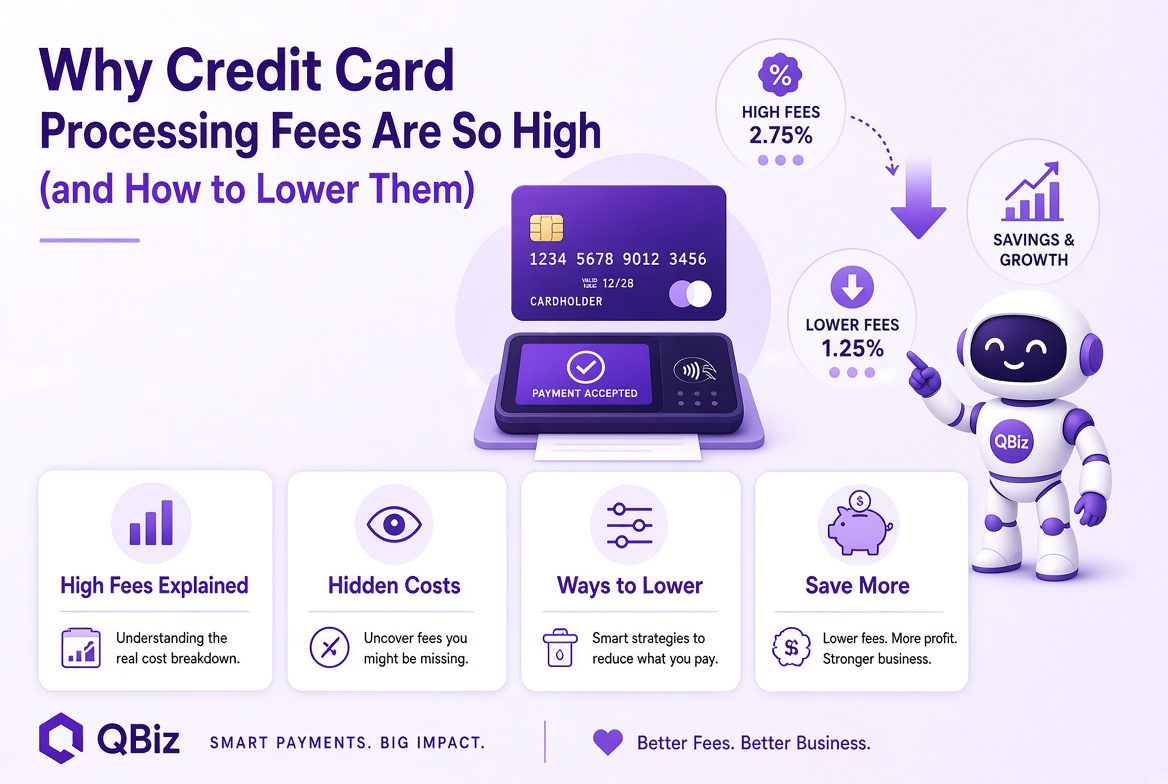
Why Credit Card Processing Fees Are So High (and How to Lower Them)
If you've ever opened a monthly merchant statement and wondered where all those charges came from, you're not alone. For many small businesses, credit card processing fees are one of the largest costs after payroll and rent. And because the charges are split across several parties and buried in confusing line items, they're hard to spot and even harder to question.
This guide explains why credit card processing fees are so high, what you're actually paying for, and which steps can lower your costs without hurting your sales.
How Much Do Credit Card Processing Fees Cost?
Most small businesses pay somewhere between 1.5% and 3.5% of each transaction, often plus a small fixed fee per sale. The exact rate depends on your business type, how customers pay, and the pricing model your provider uses.
A quick example: on a $100 sale, a rate of 2.9% plus 30 cents costs you $3.20. That looks small until you process thousands of dollars a month. At $30,000 in monthly card sales, even a one-point difference in your effective rate is $300 a month, or $3,600 a year.
Why Credit Card Processing Fees Are So High
Every card payment passes through several companies, and each one takes a cut. Here's who is involved.
1. Interchange fees (the biggest piece)
Interchange is paid to the bank that issued your customer's card. It usually makes up the largest share of your total cost. Rates are set by the card networks and vary widely based on:
Card type: Rewards and premium cards cost more than basic debit or standard credit cards, because issuers use that revenue to fund points and cash back.
How the card is used: Swiped, dipped, or tapped (card-present) payments carry lower risk than online or keyed-in (card-not-present) payments, so they usually cost less.
Your industry: Businesses seen as higher-risk, or those with more chargebacks, can face higher rates.
Transaction size and data: Some categories have different rates depending on ticket size or how much data is submitted with the transaction.
Interchange is non-negotiable in the sense that your processor can't waive it. That's why understanding it matters.
2. Card network assessment fees
Visa, Mastercard, Discover, and American Express charge their own fees for using their networks. These are typically a small percentage of each transaction plus occasional per-transaction charges. They're a smaller slice of the total, but they're still passed on to you.
3. Processor and acquirer markup
This is the part that varies most from provider to provider. Your payment processor adds its own markup on top of interchange and network fees to cover its services, support, and profit. Markup can be a percentage, a fixed per-transaction fee, or both, and it's where the difference between a good and a bad deal shows up.
4. Extra and hidden fees
Beyond per-transaction costs, many statements include:
Monthly account or statement fees
Gateway fees for online payments
PCI compliance fees (and non-compliance penalties)
Chargeback fees
Early termination fees
Minimum monthly processing fees
Fees for equipment leases or rentals
Each is small on its own, but together they can noticeably raise your effective rate.
5. Complicated pricing models
Some providers use tiered pricing, which sorts transactions into "qualified," "mid-qualified," and "non-qualified" buckets. The provider decides which transactions land in which bucket, so it's hard to know why you were charged a higher rate. Because of this lack of clarity, tiered pricing often costs more than transparent alternatives.
Common Pricing Models: Which Costs Less?
Pricing model
How it works
Best for
Flat-rate
One fixed percentage (plus a per-transaction fee) on every sale
Very small or new businesses that value simplicity
Interchange-plus
Actual interchange and network costs plus a fixed, visible markup
Growing businesses that want transparency
Tiered
Transactions grouped into buckets with different rates
Rarely the best choice; often the least transparent
Subscription
Monthly fee plus interchange at cost with small per-transaction fees
Higher-volume businesses
Flat-rate is easy to understand but can be expensive as volume grows. Interchange-plus takes more effort to read but generally lets you see, and negotiate, exactly what you pay.
How to Lower Your Credit Card Processing Fees
You can't change interchange rates, but you can control a lot of what surrounds them. These are the steps most likely to make a real difference.
Review your statement line by line
Start by finding your effective rate: total fees divided by total card sales for the month. Compare it to what you were quoted. If it's noticeably higher, look for unexplained fees, duplicated charges, or a pricing model you didn't agree to.
Ask for interchange-plus pricing
If you're on tiered or a high flat rate and your volume has grown, ask whether you qualify for interchange-plus pricing. Seeing the true cost and the markup separately makes it much easier to judge whether your provider is fair.
Negotiate, and compare quotes
Processors expect negotiation, especially from businesses with steady volume. Get quotes from at least two or three providers, and ask each for a full fee schedule, not just the headline rate. Look closely at contract length, cancellation terms, and equipment costs.
Take more payments in person
Card-present transactions generally cost less than online or keyed-in ones. If you run a storefront, use a chip reader or tap-to-pay terminal instead of typing in card numbers manually.
Submit clean, complete transaction data
Using address verification (AVS) and security code (CVV) checks can reduce fraud risk and may help you qualify for better rates. Batching and settling transactions promptly, usually daily, also helps avoid downgrades to higher-cost categories. If you sell to businesses, submitting extra invoice details (often called Level 2 or Level 3 data) can qualify some commercial card payments for lower interchange.
Reduce chargebacks
Chargebacks come with fees and can push you into a higher-risk category. Use clear billing descriptors, keep good records, respond to disputes on time, and make your refund policy easy to find.
Stay PCI compliant
Complete your PCI compliance requirements on time. Many providers charge extra when businesses haven't validated compliance, and a data breach costs far more.
Steer large payments to lower-cost methods
For big invoices, offering bank transfer (ACH) as an option can save money, since a percentage-based card fee grows with the invoice size. Just make sure it's convenient for your customers.
Learn the rules before adding surcharges or discounts
Some businesses try to offset processing costs by adding surcharges or offering cash discounts. These practices are regulated, and the rules differ by state, card network, and card type. Check the current requirements and get professional advice before making any change, so you stay compliant and keep customers' trust.
Warning Signs Your Processor Is Overcharging You
Your effective rate is far above what you were originally quoted
Your statement is hard to read, or fees are grouped under vague labels
You were locked into a long contract with high early termination fees
Your rate has crept up over time without explanation
You're paying for equipment leases that cost more than the hardware is worth
Any of these is a good reason to ask questions or shop around.
Key Takeaways
Credit card processing fees are high because several parties, including the issuing bank, card network, and processor, each take a portion of every sale.
Interchange is the largest cost and isn't negotiable, but processor markup and extra fees often are.
Pricing model matters: transparent structures like interchange-plus make costs easier to understand and compare.
Small operational habits, such as accepting card-present payments, submitting clean data, and preventing chargebacks, can quietly lower what you pay.
Regularly review your statement and compare providers, because the best deal for a small business today may not be the best at higher volume.
Frequently Asked Questions
What is a normal credit card processing fee for a small business?
Most businesses pay between roughly 1.5% and 3.5% per transaction, sometimes with a small fixed fee added. Your rate depends on your industry, card mix, and pricing model.
Why do some cards cost more to accept?
Rewards and premium cards carry higher interchange rates because issuers fund points and cash back through those fees. Online and keyed-in payments also cost more because they carry a higher fraud risk.
Can I negotiate credit card processing fees?
Yes. You can't negotiate interchange, but you can negotiate your processor's markup, monthly fees, and contract terms, particularly if you have steady or growing volume.
What is the difference between interchange and processing fees?
Interchange goes to the card-issuing bank, while processing fees cover your provider's markup, services, and support. Your total cost combines interchange, network assessments, and your processor's charges.
How can I find my effective rate?
Divide the total fees on your monthly statement by your total card sales for that month. Compare the result to the rate you were originally quoted.
Credit card processing fees rarely come down to one simple number — they’re the result of interchange, network fees, your processor’s markup, and a handful of smaller charges stacked on top of each other. Understanding where each piece comes from is the first step. Actually lowering your effective rate takes a closer look at your real statements, not just a quoted percentage.
myQBiz.ai’s Merchant Services takes that off your plate — it reviews your actual processing statements, flags every fee that’s quietly adding to your cost, and shows you your true effective rate side by side with what you’d pay on myQBiz.ai. There’s no obligation to switch, and no pressure — just a clear picture of where your money is actually going.