Zero Fee Credit Card Processing: How Dual Pricing Saves You Money
What “zero fee” credit card processing really means, how dual pricing works, potential savings, and the compliance rules you need to follow before launching it. (Compliance pending on this topic per client’s note — confirm before publishing.)
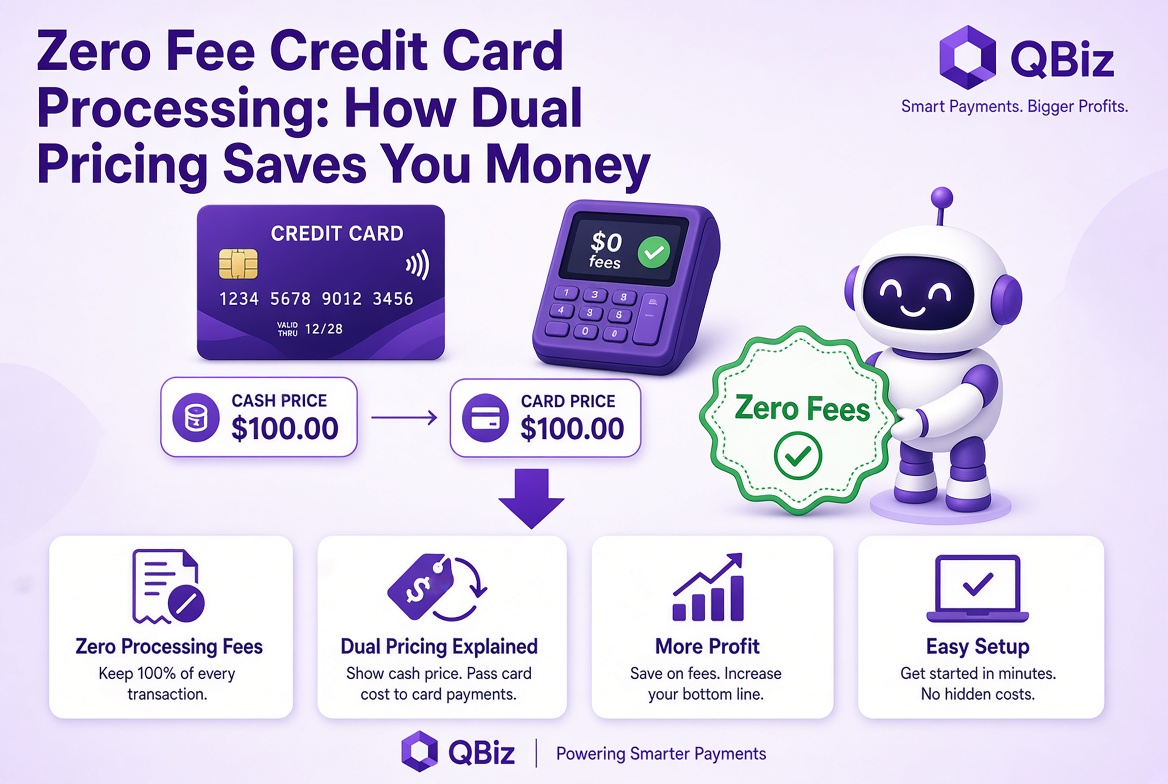
Zero Fee Credit Card Processing: How Dual Pricing Saves You Money
Card fees are a fixed cost of doing business, which is why zero fee credit card processing sounds so appealing. But the phrase can be misleading. The fees don't disappear; they move. This guide explains what zero fee processing really means, how dual pricing works, what it can save you, and the rules to check before you use it.
What Is Zero Fee Credit Card Processing?
Zero fee credit card processing is a marketing term for a setup where the merchant pays little or no processing cost on card sales. Instead of the business absorbing the cost, it is covered through a dual pricing or cash discount program.
The card networks and issuing banks still charge interchange on every transaction. What changes is who pays. So "zero fee" describes the merchant's experience, not the absence of costs. Some programs also carry a monthly fee, equipment charges, or other line items, so always read the full agreement.
How Dual Pricing Works
Dual pricing means showing two prices for the same product or service: a lower cash price and a slightly higher card price. The customer chooses how to pay, and the card price includes the cost of processing.
For example, an item priced at $100 in cash might be $103.50 by card. A customer who pays cash gets the lower price, and a customer who pays by card covers the processing cost. Both prices should be visible before the purchase, on menus, price tags, signs, and your point-of-sale screen. Most modern POS systems can display and calculate both automatically.
Dual Pricing vs. Surcharging vs. Cash Discounts
These terms are often mixed up, but they are treated differently under card network rules and state law.
Approach
How it works
Key point
Dual pricing
Two prices are shown up front: a cash price and a card price.
Both prices must be visible before purchase.
Surcharge
A fee is added to the regular price at checkout when paying by card.
Tighter limits apply and some states restrict it.
Cash discount
The listed price is the card price; cash payers get a discount.
Must be presented as a discount, not a penalty.
How Much Can Dual Pricing Save You?
Savings depend on your card volume and how customers choose to pay. Say a business runs $40,000 a month in card sales at an effective rate of 2.9%. That's about $1,160 a month, or $13,920 a year, in processing costs. Under a dual pricing program, customers who pay by card cover most or all of that cost, and customers who switch to cash generate no card fees at all.
That example is illustrative. Your real result depends on your current effective rate, your program's fees, and how many customers pay by card. Compare your last three monthly statements with the program's written fee schedule before assuming any number.
Benefits of Dual Pricing
• Lower processing costs, which can protect thin margins.
• More predictable expenses, since the cost is tied to customer choice rather than your monthly volume.
• A built-in incentive for customers to pay with lower-cost methods.
• Little change to your base operations if your POS supports it.
Drawbacks and Risks to Consider
• Customer reaction: Some shoppers dislike seeing a higher card price, even when it is clearly posted. Poor signage or staff who can't explain it makes this worse.
• Competitive pressure: If nearby competitors advertise one flat price, your card price may look higher.
• Possible sales impact: Fewer or smaller card purchases can offset your savings.
• Program fees: Some "zero fee" plans include monthly charges, software fees, or contract terms that reduce the benefit.
• Compliance risk: Errors in pricing display, receipts, or disclosure can lead to penalties, disputes, or loss of processing privileges.
Rules You Need to Follow
Dual pricing is regulated, and the rules vary by state, card network, and card type. Before launching, check the following.
• Disclosure: Post clear notice of both prices before the customer pays, and make sure receipts show the pricing accurately.
• State law: Some states restrict or prohibit surcharges, and others have specific requirements for cash discounts. Confirm what applies where you operate.
• Card network rules: Visa, Mastercard, and other networks set their own conditions, including how debit and credit cards may be treated.
• Your merchant agreement: Confirm that your provider permits the program and explains how it is set up.
Rules change, so get advice from a qualified attorney or compliance professional and re-check requirements periodically. A program that isn't set up correctly can cost far more than it saves.
Is Dual Pricing Right for Your Business?
It tends to fit businesses with high in-person card volume and tight margins, such as restaurants, salons, auto repair shops, and retail stores. It may be a weaker fit if you sell mostly online, compete heavily on price, or serve customers who are sensitive to any visible price difference. Think about how your own customers pay and how they would react before you decide.
How to Get Started
1. Calculate your current effective rate by dividing monthly fees by monthly card sales.
2. Confirm your state and card network requirements.
3. Ask any provider for the full fee schedule and contract terms in writing.
4. Update your prices, signage, POS settings, and receipts.
5. Train staff to explain the pricing in one or two simple sentences.
6. Track sales, card mix, and customer feedback for 60 to 90 days, then adjust.
Frequently Asked Questions
Is zero fee credit card processing really free?
Not entirely. Interchange and network costs still exist. The program shifts them to customers who pay by card, and some plans have separate monthly or equipment fees.
Is dual pricing legal?
It is allowed in many places, but rules differ by state, card network, and card type. Confirm the requirements that apply to you before starting.
What is the difference between dual pricing and surcharging?
Dual pricing displays a cash price and a card price up front. A surcharge adds a fee to the regular price at checkout. They follow different rules.
Will customers stop buying from me?
Some may react, especially if the pricing isn't clearly explained. Transparent signage and a simple explanation reduce that risk.
Dual pricing can genuinely eliminate your processing costs, but getting it right means getting the setup right — correct signage, compliant disclosure, and a provider who’s transparent about every fee in the program, not just the headline “zero fee” claim.
myQBiz.ai’s Merchant Services reviews your actual processing statements and shows you exactly what you’d pay under a dual pricing setup, compared to your current effective rate — fully disclosed, properly compliant, with no obligation to switch.