How Much Business Loan Can I Get Based on My Revenue?
Revenue sets the ceiling, but cash flow decides the amount. Learn how lenders size a loan and how to estimate yours.
How Much Business Loan Can I Get Based on My Revenue?
there’s no single formula, because lenders look at more than revenue. Many lenders size a loan from your cash flow, meaning how much money is left after expenses to cover a new payment. Revenue sets the ceiling, but your profit, credit, time in business, and existing debt decide how much of that ceiling you actually reach. You can get a realistic estimate yourself in a few minutes.
If you’ve wondered whether $300,000 in sales means a $300,000 loan, it doesn’t. Here’s how a business loan amount is really set, and how to estimate your own range before you apply.
Does Revenue Decide How Much You Can Borrow?
Revenue matters, but it’s only the starting point. It shows lenders how much money moves through your business. What they want to know next is how much of it you keep.
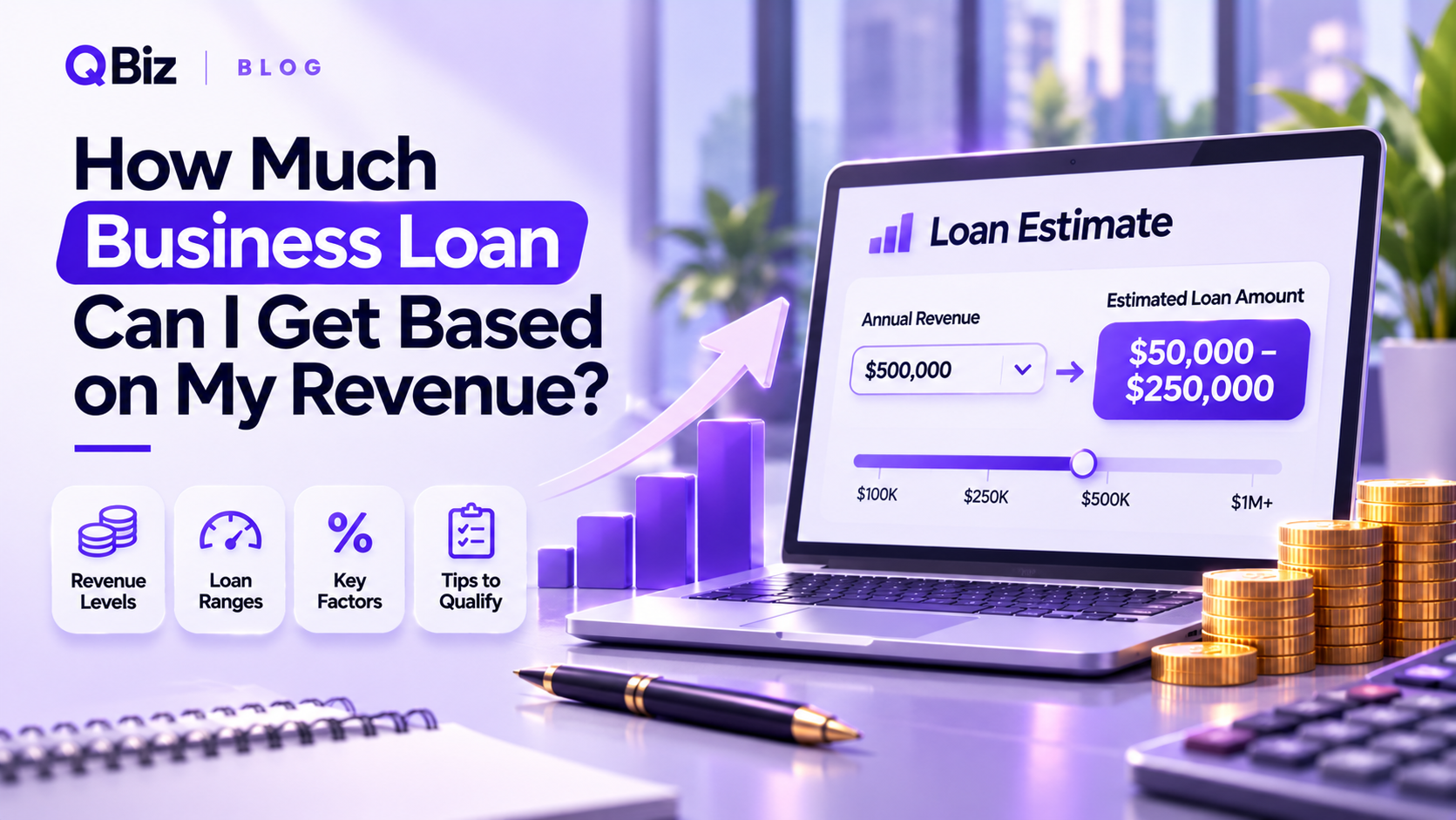
Two businesses with the same $500,000 in sales can qualify for very different amounts. One keeps 20% after expenses, and the other barely breaks even. The first can handle a bigger payment, so it can usually borrow more.
What Do Lenders Actually Look At?
Most lenders weigh the same handful of things, though the exact mix depends on the loan type.
Cash flow. How much you have left each month after expenses. This usually matters more than total sales.
Time in business. Many programs want at least a year or two of history. For example, equipment financing through myQBiz.ai Lending asks for at least two years in business.
Credit. Your personal and business credit affect both approval and the size of the offer. The same equipment program asks for a personal credit score of 660 or higher.
Existing debt. Payments you already make reduce what you can add.
The loan type and purpose. An SBA loan, a line of credit, and invoice financing all size amounts differently.
Meeting the minimums doesn’t guarantee approval, and each lender sets its own limits. Before you borrow, our guide to 9 questions to ask before signing any business loan walks through what to check.
How Can You Estimate Your Own Loan Amount?
Here’s a simple way to get a rough range. It won’t match a lender’s offer, but it shows whether your plan is realistic.
Step 1: Find your monthly cash available for debt payments. Take your average monthly profit before loan payments. Use the last six to twelve months, not your best month.
Step 2: Leave a cushion. Lenders like to see more cash coming in than the payment going out. A common way to measure this is the debt service coverage ratio, which divides cash available by payments. Many lenders want it comfortably above 1, and the target varies.
Step 3: Work backward to a payment. Divide your monthly cash by the ratio you’re aiming for to get a payment you can afford.
Step 4: Turn the payment into a loan amount. The amount depends on the rate and the length of the term, so use a loan calculator.
What Does That Look Like in Numbers?
Here’s an illustration with made-up figures, so treat it as an example, not an offer. Say a business has $40,000 in monthly sales, which is $480,000 a year, and $6,000 left each month before loan payments.
If it aims for a cushion of 1.25, the payment it can comfortably afford is $6,000 divided by 1.25, or $4,800 a month.
At an assumed 12% annual rate over 36 months, a $4,800 monthly payment supports roughly $144,000 in borrowing. A higher rate or a shorter term would lower that number, and a longer term or lower rate would raise it.
That’s about 30% of annual revenue here, but it’s a result of the math, not a rule. Thinner profit means less, and stronger margins mean more.
Does the Type of Loan Change the Amount?
Yes, a lot. Each product ties the amount to something different.
Working capital loans and lines of credit are usually sized from your sales and cash flow. Equipment financing is tied to the price of the equipment. Invoice financing relates to the value of your unpaid invoices, and purchase order financing relates to confirmed orders. SBA loans can reach larger amounts but involve more documentation and review.
For a full look at the options, our guide to small business financing options compares them side by side.
How Can You Qualify for a Higher Amount?
Keep your financial records clean and consistent across your bank, accounting software, and tax filings. Pay down existing debt where you can. Show steady cash flow, not just one strong month. And explain any dip in revenue before the lender asks. If you’re not sure where you stand, our checklist on whether your business is ready for a loan is a good place to start.
What If Your Revenue Is Low or New?
A newer business has fewer options and usually smaller amounts, but options still exist. Lenders may lean more on personal credit, collateral, or specific assets. Our guide to SBA loans for new businesses covers what’s possible without a long history.
How Does myQBiz.ai Help You Find Your Number?
Guessing is hard when your sales sit in one tool and your costs in another. The free AI Business Advisor connects to Stripe, Shopify, and QuickBooks, and answers plain-English questions about your revenue, cash flow, and profit. That makes it easier to see how much payment your business can really support before you apply.
When you’re ready, myQBiz.ai Lending brings nine loan programs into one guided application, with programs ranging from $10K to $100M depending on the program. You can check your eligibility in about two minutes with a soft credit inquiry, which doesn’t affect your credit score. A human loan specialist can walk through your numbers and explain which programs may fit.
Key Takeaways
Revenue sets the ceiling, but cash flow decides the amount.
Many lenders size a loan by how comfortably your profit covers the payment.
Estimate your range by working backward from a payment you can afford.
The loan type changes how the amount is set.
Borrow what you can repay in a slow month, not the maximum offered.
Frequently Asked Questions
How much business loan can I get based on my revenue? It depends on your cash flow, credit, time in business, existing debt, and the loan type. Revenue shows the scale of the business, but profit decides how large a payment you can support.
What is a debt service coverage ratio? It’s your cash available for debt payments divided by your debt payments. A higher ratio gives lenders more comfort, and the level they want varies by lender.
Can I get a business loan with low revenue? Sometimes. Options may be narrower and amounts smaller, and lenders may weigh credit, collateral, or specific assets more heavily.
Does checking my eligibility affect my credit score? Not with myQBiz.ai Lending. It uses a soft credit inquiry. A hard inquiry only happens if you choose a program and complete a full application.
See How Much You May Qualify For
Your numbers hold the answer, and a quick eligibility check can show which programs fit your business. Approval and amounts depend on your situation, and a specialist can help you understand your options.
Check your eligibility with myQBiz.ai Lending. It takes about two minutes, with no impact on your credit score.