
Why Small Businesses Struggle With Financial Visibility (and How to Fix It)
Most small businesses can't see their true financial picture in real time. Here's why financial visibility is so hard — and how an AI business advisor finally fixes it.
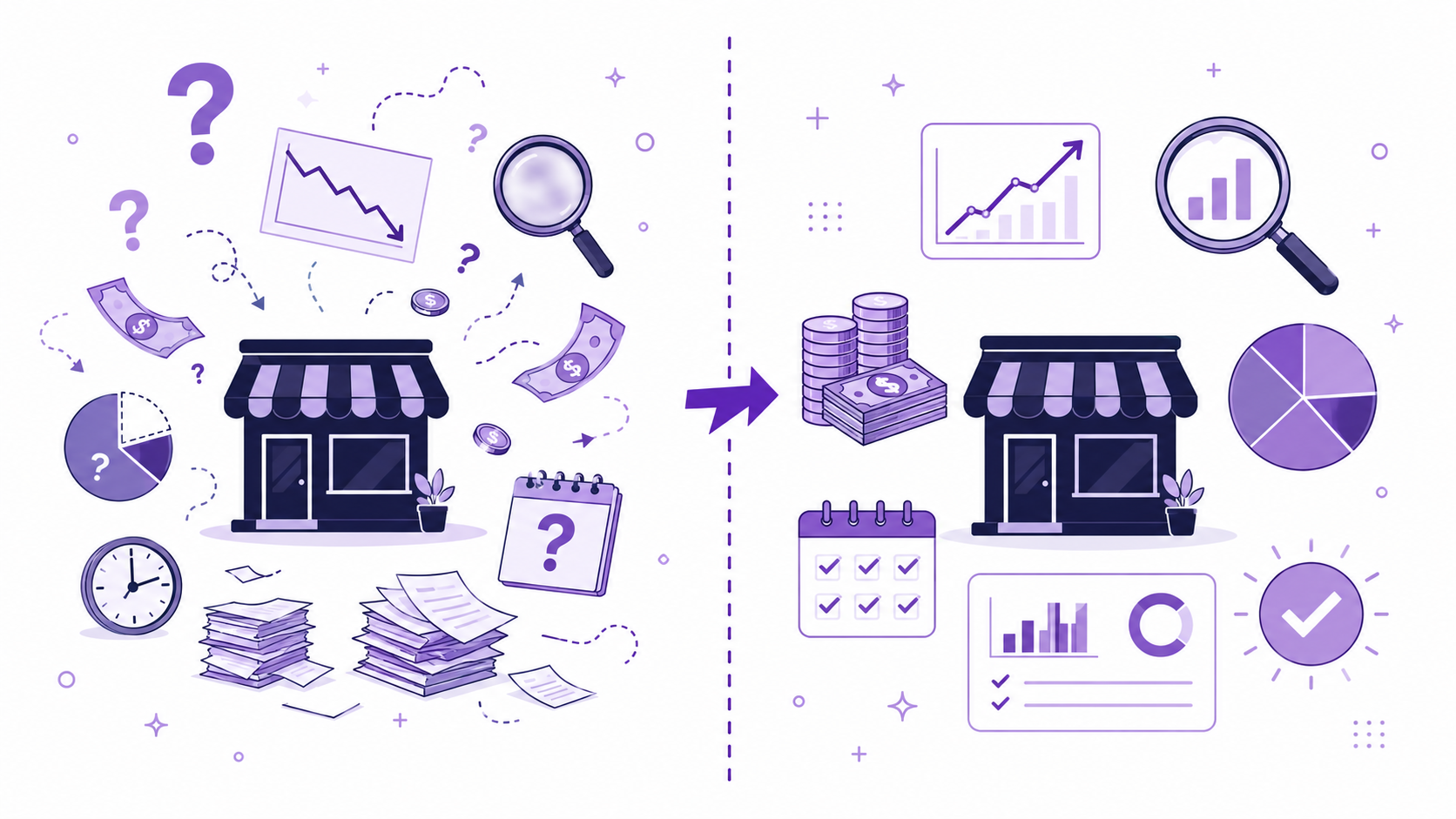
Ask ten small business owners how last month went, and most will tell you what their bank balance is — not what they actually earned, what they kept, or where it all went. That's not carelessness. These are sharp, hardworking people running real businesses. The problem is that the whole setup is quietly stacked against clarity.
Financial visibility — knowing, at any moment, how your business is really doing — sounds like table stakes. Big companies have it: teams of analysts, live dashboards, someone whose entire job is to answer "how are we doing?" Small businesses get a shoebox of logins and a gut feeling. Here's why that gap exists, what it costs, and how to close it.
What financial visibility actually means
Visibility isn't your bank balance. A balance tells you what's in the account today; it says nothing about whether that money is already spoken for, where it came from, or whether the trend is up or down.
Real visibility means seeing the full picture in something close to real time: how much revenue you're truly generating, how much you're keeping after costs and fees, what's driving the good months, and what's dragging on the bad ones. It's the difference between "there's $30K in the account" and "we netted $12K last month, mostly from one channel, and refunds are creeping up." One is a number. The other is something you can act on.
Why it's so hard for small businesses
The visibility gap isn't a discipline problem. It comes from a handful of very real obstacles.
Your data is fragmented. Sales live in Shopify, payments in Stripe, books in QuickBooks, cash in a bank account, payroll somewhere else. No single tool sees the whole business, so you're forever reassembling the story by hand.
The tools answer different questions. Your sales platform thinks in orders. Your processor thinks in payments minus fees. Your accounting software thinks in journal entries. Each is built for its own job, not for giving you one straight answer about overall performance.
Everything is backward-looking. Most owners only learn how a month went after the books close — which means you find out about a problem in the second week of the following month, long after you could have done anything about it.
Spreadsheets go stale instantly. The DIY fix is a spreadsheet, but it's accurate for about a day. By the time you've built it, the numbers have already moved.
Real help has been too expensive. The traditional answer to all of this is to hire a CFO or analyst — a cost that simply doesn't fit most small businesses. So the visibility that bigger companies take for granted stays out of reach.
If any of that sounds like your month-end routine, there's a faster path. See your whole business in one view with My Qbiz.AI — no spreadsheet, no waiting for the books to close.
What poor visibility actually costs
It's tempting to treat this as a nice-to-have. It isn't. When you can't see clearly, you make decisions on vibes — pouring money into an ad channel that feels like it's working, or holding back on hiring when you could afford it.
You also react slowly. A product that's quietly losing money, a subscription that crept up, a marketing spend that stopped converting — without visibility, these run for months before you notice. And then there are the cash surprises: the tax bill you didn't plan for, the slow month you didn't see coming. Every one of those is expensive, and most are avoidable with a clearer view. The hidden cost is the constant low-grade stress of running a business you can't fully see.
What good visibility looks like
The goal is to move from reactive to real-time. Instead of waiting for month-end, you see your numbers as they happen. Instead of one balance, you see revenue, costs, margins, and trends in a single place. Instead of digging for answers, you ask a question and get one.
This is what proper revenue analytics small business owners have always needed actually delivers: not more charts to decode, but clear answers to the questions that keep you up at night. Is the business growing? Which products carry it? Can I afford this hire? Try My Qbiz.AI free while it's in launch and trade the guesswork for a number you can trust.
How AI finally closes the gap
For years, the only way to get this kind of clarity was to hire for it. That's changed. An AI financial advisor for small business does the part that used to require a person: it connects your scattered tools, keeps the picture current as money moves, and translates the mess into plain answers.
That's the quiet revolution here. An AI business advisor gives a solo founder or a ten-person company the same visibility a finance team provides at a large company — without the salary, the setup, or the spreadsheets. Connect your accounts, and an AI business insights tool turns Shopify, Stripe, and QuickBooks into one clear story you can question in everyday language.
You don't fix visibility by working harder at spreadsheets. You fix it by connecting your data once and letting it stay current. Start by linking your accounts and asking a single real question about last month — then notice how different it feels to actually know the answer.
Frequently asked questions
What does financial visibility mean for a small business? It means being able to see how your business is really performing at any moment — your true revenue, costs, profit, cash position, and the trends behind them — rather than just checking your bank balance. Good visibility turns scattered data into a clear, current picture you can make decisions from.
Why can't I just use QuickBooks for financial visibility? QuickBooks is excellent for accounting, but it sees mainly what flows into your books — not the full operational picture across your sales platform and payment processor, and usually on a lag. Pairing it with Shopify and Stripe data in one analyzed view gives you the real-time visibility accounting software alone can't.
How can a small business improve financial visibility? Start by bringing your data together: connect your sales, payment, and accounting tools so you're not reassembling the picture by hand. Review the key numbers on a regular rhythm, and use a tool that keeps everything current and answers questions in plain language instead of relying on stale spreadsheets.
What's the cost of poor financial visibility? It shows up as decisions made on guesswork, slow reactions to problems like an unprofitable product or rising ad costs, unexpected cash crunches, and ongoing stress. These costs are largely avoidable with a clear, current view of your finances.
Can AI really help small businesses understand their finances? Yes. An AI financial advisor for small business connects your tools, keeps the data current, and explains what's happening in everyday language — delivering the kind of revenue analytics and ongoing visibility that used to require a dedicated finance hire, at a fraction of the cost.