What Is Merchant Services? Guide for Business Owners | 2026
Learn what merchant services are, how payment processing works, what fees businesses pay, and how to choose the right merchant services provider for your business.
What Is Merchant Services? Guide for Business Owners | 2026
If your business accepts credit cards, debit cards, or online payments, you're already using merchant services whether you've thought about it or not. Most business owners only start paying close attention once they notice how much of every sale quietly disappears into processing fees each month.
This guide breaks down what merchant services actually are, how they work, what they cost, and how to choose a provider that doesn't eat into your margins.
What Is Merchant Services? Definition
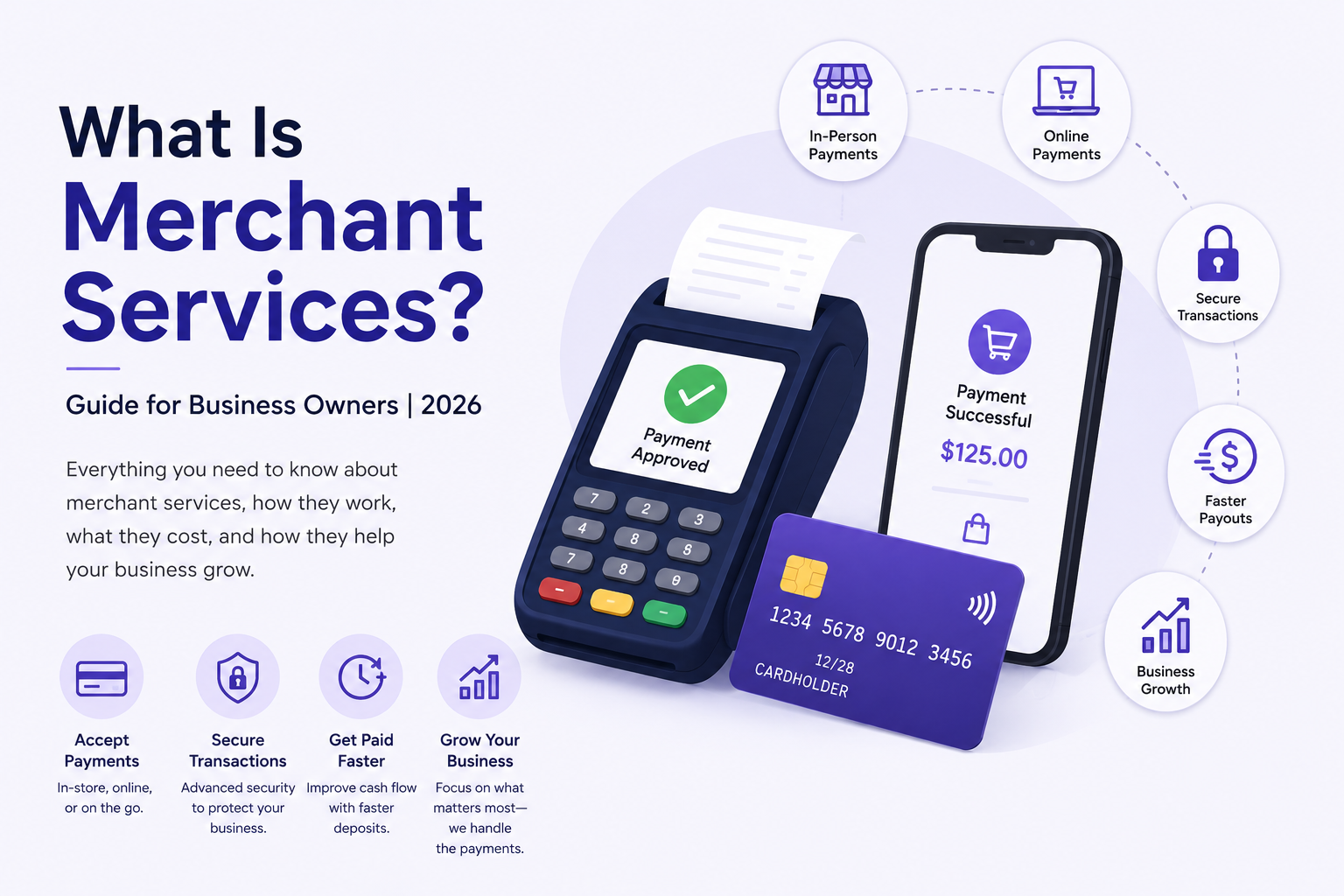
Merchant services is the umbrella term for the tools, technology, and financial infrastructure that let a business accept and process electronic payments — credit cards, debit cards, mobile wallets, and online transactions. It covers everything from the card reader at your counter to the software that authorizes a payment and moves the money into your bank account.
Simply put: any time money moves electronically from a customer to your business, merchant services are working behind the scenes to make it happen securely.
How Do Merchant Services Work?
A single card swipe or online checkout triggers a fast chain of steps:
Initiation — The customer pays by card, tap, or online checkout.
Transmission — Payment details are sent securely to the provider.
Authorization — The provider routes the transaction to the card network, which checks with the customer's bank.
Verification — The bank approves or declines based on funds and fraud checks.
Settlement — Approved funds move into the merchant's account, usually within one to two business days.
The whole process takes seconds — but nearly every step in that chain has a fee attached, which is where most processing costs come from.
Types of Merchant Services
Payment Processing — the core function of moving funds from a customer's card or account into your business account, covering credit, debit, and ACH transfers.
POS (Point of Sale) Systems — hardware like card readers and terminals paired with software that handles sales, inventory, and reporting, often cloud-based.
Online Payment Gateways — the e-commerce equivalent of a POS system, securely connecting your checkout page to the customer's bank and encrypting card data in transit.
Merchant Cash Advances — financing tied to future card sales, repaid as a percentage of daily transactions. Fast to access, but usually one of the more expensive ways to fund a business.
What Do Merchant Services Actually Cost?
This is the part most guides skip — and the part that matters most to your bottom line. Traditional merchant services typically charge a mix of:
Interchange fees — set by card networks, usually 1.5%–3.5% per transaction
Processor markup — an added percentage or flat fee on top
Monthly account fees — flat charges just to keep the account open
PCI compliance, statement, and equipment fees — smaller charges that add up over a year
On a business doing $50,000 a month in card sales, even a "small" 2.5% blended rate adds up to $1,250 a month — every month — just to accept payment for sales you already made.
How to Choose the Right Provider
Before signing with any merchant services provider, compare on:
Transparent pricing — flat, published rates, no hidden add-ons
Security — PCI DSS compliance and built-in fraud protection
Integration — does it connect with the accounting and banking tools you already use?
Support — real help when a payment issue happens, not just a ticket queue
Total monthly cost — not just the headline rate, but everything combined
How QBiz Merchant Services Is Different
QBiz Merchant Services is built around a simple idea: you shouldn't lose a chunk of every sale just to get paid. Instead of the standard blended-rate model, QBiz offers a 0% processing fee structure — so more of every transaction stays in your business instead of going to a processor.
Because QBiz Merchant Services sits inside the same platform as the QBiz AI Business Advisor and QBiz Lending, your payment data doesn't live in a separate silo. It feeds directly into the same view that already tracks your revenue, cash flow, and profitability — so you can see how card sales affect your business in real time, and access funding when you need it, without switching platforms.
Frequently Asked Questions
What are typical merchant services fees? Most providers charge interchange fees, a processor markup, and monthly fees — often 2%–3.5% per transaction plus flat monthly charges.
Can a business really process payments with 0% fees? Yes — QBiz Merchant Services is built specifically around a 0% processing fee model, unlike the traditional blended-rate approach.
How long does setup take with a new provider? Usually anywhere from a few hours to a couple of business days, depending on the provider and your documentation.
Do merchant services cover both online and in-person sales? Yes. Payment processing, POS systems, and online gateways all fall under merchant services, supporting storefronts and e-commerce alike.
Final Thoughts
Merchant services aren't optional for a modern business — but what you pay for them is negotiable. Before accepting another month of blended-rate fees eating into your margins, it's worth checking what a 0% processing model looks like for your numbers.
See how much you could save on every sale. Get your free merchant savings estimate with QBiz and keep more of what you earn.