
How to Track Your Monthly Expenses: A Simple 6-Step Guide for Beginners
It was the first week of the month. Aaron had just received his salary—$2,500. He told himself that this time, he would finally save something. But 20 days later, when he opened his banking app, his balance read just $180. A few coffee runs, some ride-sharing trips, a couple of o
It was the first week of the month. Aaron had just received his salary—$2,500. He told himself that this time, he would finally save something. But 20 days later, when he opened his banking app, his balance read just $180. A few coffee runs, some ride-sharing trips, a couple of online orders, and one spontaneous dinner with friends were small purchases that quietly added up to a big problem.
Sound familiar?
If yes, you are not alone. Many people struggle financially, and more often than not, the reason is not that they do not earn enough. The real problem is that they do not know where their money is going.
That is exactly the gap expense tracking fills. It is a simple habit that makes you aware of your spending. When you know where every dollar goes, you can make better decisions and gradually improve your financial situation no matter your income level.
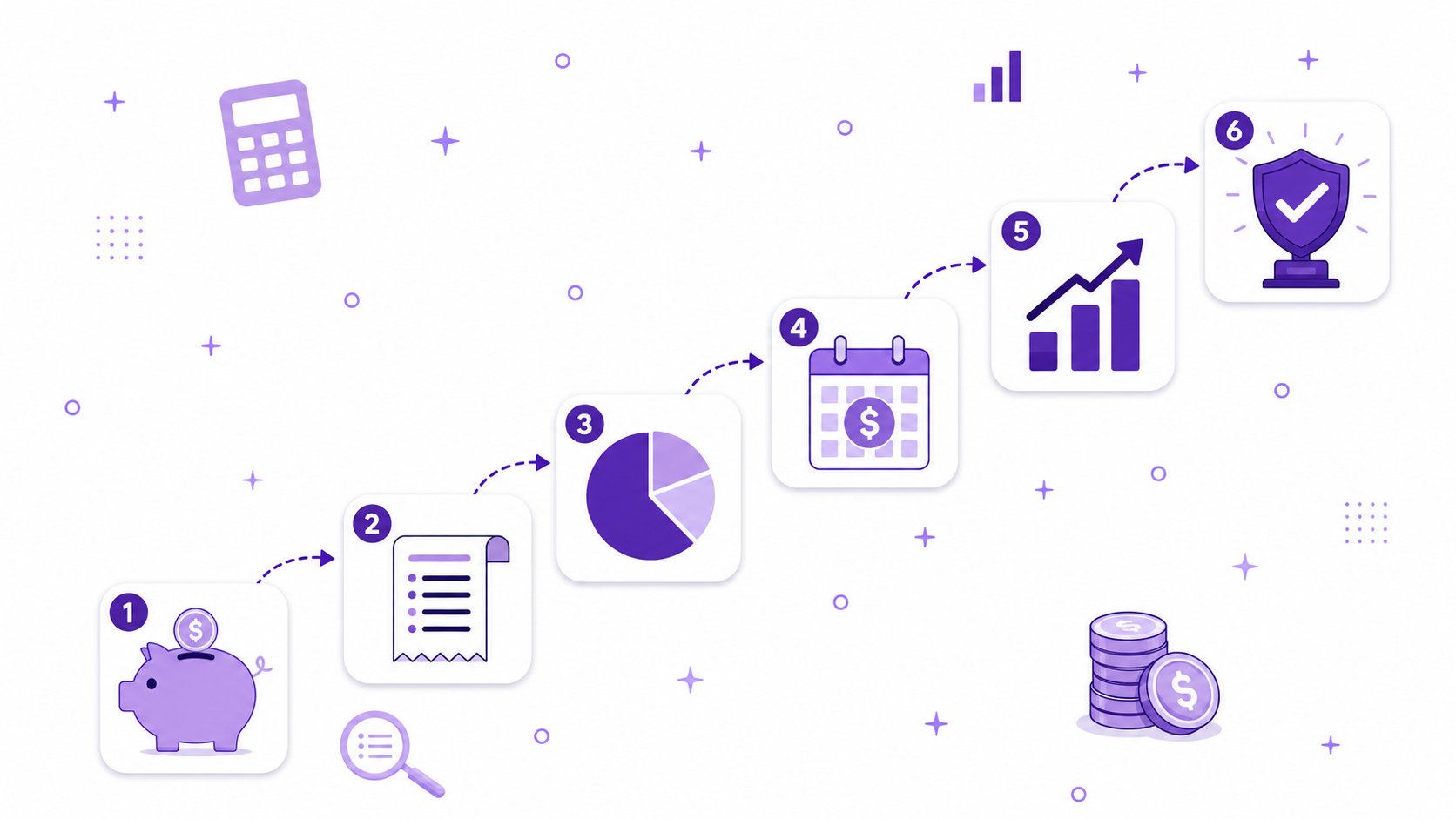
In this article, we will walk you through a simple 6-step system to start tracking your monthly expenses. No accounting degree required, no complicated spreadsheets, no financial jargon. Just a clear, beginner-friendly process that actually works.
Why You Should Start Tracking Your Expenses Today
Most people assume that budgeting and expense tracking are only for people who are broke or struggling. The truth is the opposite — people who track their expenses are the ones who stop struggling.
Here is why this one simple habit can change your financial life:
You finally understand your spending habits. Most of us have a rough idea of where our money goes, but a rough idea is not enough. Tracking gives you exact numbers, and exact numbers reveal patterns you never noticed before.
You spot unnecessary expenses. That forgotten subscription. The daily coffee adds up to $60 a month. The impulse purchases that felt small in the moment. Tracking brings all of these into the light.
You break the paycheck-to-paycheck cycle. When you see your full financial picture, you can start making small adjustments that free up money — even on the same income you have today.
You reduce financial stress. A huge part of money anxiety comes from uncertainty. When you know exactly what is coming in and going out, that uncertainty disappears.
You save more consistently. Tracking does not just show you where money goes—it helps you redirect it. When you find leaks, you can plug them and move that money toward savings.
You reach your financial goals faster. Whether you want an emergency fund, to pay off debt, or to save for a vacation—tracking gives you the clarity to get there faster.
The good news? You do not need to be an accountant or have a complicated spreadsheet. All you need is the simple 6-step system below.
Step 1: Know How Much Money Comes In
Calculate Your Monthly Income
Before tracking where your money goes, you need to know exactly how much you have coming in each month. This sounds obvious, but many people skip this step entirely.
Add up every source of money that comes in regularly:
Salary after taxes — your actual take-home pay, not your gross salary
Freelance income — writing, design, tutoring, or consulting work
Side hustle earnings — online store, reselling, or part-time work
Rental income — if you rent out a property or a room
Any other regular source — dividends, benefits, or family support
Practical Tip: If your income varies month to month, look at your last three months and calculate the average. This gives you a realistic number to work with.
Example: If your monthly salary is $2,500 and freelance work brings in around $300, your total monthly income is approximately $2,800. That is the number your entire budget will be built around.
Step 2: Record Every Expense
Track Every Dollar You Spend
Now that you know your income, write down everything you spend. And we mean everything — that $3 coffee, the $12 online order, the monthly streaming subscription. Every dollar counts.
Here is what to record:
Cash purchases — groceries, street food, tips
Debit and credit card transactions — restaurants, shopping, fuel
Online payments — Amazon, food delivery, online stores
Monthly subscriptions — Netflix, Spotify, gym memberships
Tools You Can Use
A small notebook or diary
Your phone's notes app
Google Sheets or Excel
A budgeting app like YNAB
Beginner Tip: Spend just 5 minutes every evening logging what you spent that day. Small purchases are the easiest to forget and the hardest to track later.
The goal right now is not to judge your spending; it is simply to see it. Awareness comes first. Change comes after.
Step 3: Categorize Your Spending
Organize Expenses into Categories
Recording expenses is just the first part. The next step is organizing them into categories so you can clearly see where your money is actually going.
Here are some simple categories to start with:
Housing — rent, mortgage, maintenance
Utilities — electricity, water, gas, internet
Transportation — fuel, ride-sharing, public transport
Groceries — supermarket, local market, household supplies
Dining Out — restaurants, cafes, food delivery
Entertainment — streaming services, cinema, outings
Healthcare — doctor visits, medicine, lab tests
Debt Payments — loan installments, credit card bills
Savings — emergency fund, investments
Miscellaneous — anything that does not fit elsewhere
Why This Matters: Without categories, your expenses are just a long list of numbers. With categories, patterns emerge instantly. You might discover that dining out costs three times more than groceries or that subscriptions are draining $80 a month without you realizing it.
Step 4: Analyze Your Spending Patterns
Identify Your Spending Leaks
Now comes the most eye-opening part. Once your expenses are recorded and categorized, it is time to actually look at them and ask yourself some honest questions:
Which category is costing me the most?
Were there any purchases I did not really need?
Am I paying for subscriptions I no longer use?
Am I spending extra just for convenience?
Example: A daily coffee run seems harmless in the moment. But $5 a day adds up to $150 a month and $1,800 a year. That is not a judgment; that is just math. And math does not lie.
This step is not about feeling guilty over past spending. It is about spotting patterns you were not aware of before. Once you see them clearly, you naturally start making smarter choices without anyone telling you what to do.
Awareness is the first step toward change. You cannot fix what you cannot see.
Step 5: Create Realistic Spending Limits
Set a Budget That Actually Works for You
Now that you know where your money is going, it is time to decide where you want it to go. This is where you create your budget but not the kind that makes you miserable.
A good budget is not about restricting yourself. It is about being intentional with your money. Here is how to set realistic limits:
Base your limits on real data—use what you learned in Step 4, not random numbers
Avoid being too strict—a budget you cannot stick to is useless
Prioritize what matters most—adjust categories based on your actual lifestyle
Example Budget (Monthly Income: $2,800)
Housing: $900
Groceries: $300
Transportation: $150
Dining Out: $100
Entertainment: $80
Savings: $400
Miscellaneous: $100
Pro Tip: Do not aim for perfection in your first month. If you overspend in one category, simply adjust the next month. A budget is a living document; it is meant to evolve as you learn more about your spending habits.
Progress always beats perfection.
Step 6: Review and Adjust Every Month
Make Expense Tracking a Lasting Habit
Creating a budget is not a one-time task. The real power comes from reviewing it consistently and making small adjustments over time.
At the end of every month, set aside 15 to 20 minutes and do the following:
Compare budget vs actual spending—where did you stay on track, and where did you overspend?
Celebrate your wins — if you spent less in a category, acknowledge it. Small wins build momentum.
Adjust where needed — if a limit was unrealistic, change it. Your budget should reflect real life.
Plan for irregular expenses—holidays, birthdays, and car maintenance should be factored in advance.
5 Tips to Stay Consistent
Staying consistent is what separates people who transform their finances from those who give up after a month. Here are five habits that help:
Spend 5 minutes every evening logging that day's expenses.
Keep receipts until your weekly review is done.
Schedule a weekly money check-in every Sunday for 15 minutes.
Automate your savings so they transfer before you can spend them.
Reward yourself when you hit a monthly goal.
Reminder: Your budget will change as your life changes, like a new job, a move, or a growing family. That is completely normal. The goal is not a perfect budget. The goal is a habit that keeps you in control.
Avoid These Expense Tracking Mistakes
Even with the best intentions, beginners often fall into the same traps. Here are the most common mistakes and how to avoid them:
Ignoring small purchases. A $2 here, a $5 there—these feel too small to bother recording. But small purchases are often where the biggest leaks hide. Track everything, at least for the first month.
Forgetting annual expenses. Car insurance, membership renewals, and holiday gifts do not show up every month, but they will eventually. Set aside a small amount each month so they never catch you off guard.
Making the budget too strict. A budget that cuts out everything enjoyable is a budget you will abandon by week two. Leave room for fun. A sustainable budget always beats a perfect one.
Giving up after one bad month. Overspending one month does not mean you have failed. It means you are human. Reset, adjust, and keep going. Consistency over time is what creates real change.
Tracking inconsistently. Tracking for two weeks and then stopping gives you incomplete data and zero momentum. Make it a daily habit, even if it only takes five minutes.
Consistency always beats perfection. One bad week does not erase a good month.
Frequently Asked Questions
How long does it take to see results from expense tracking?
Most people notice patterns and spending leaks within the first two to four weeks. Meaningful financial improvements like building savings or paying off small debts typically start showing within two to three months of consistent tracking.
Do I need a special app to track my expenses?
Not at all. A simple notebook or your phone's notes app works perfectly fine, especially when you are just starting out. Apps like Mint or YNAB are helpful but not necessary. The best tool is the one you will actually use every day.
What if my income changes every month?
Use a conservative average based on your last three months of earnings. Build your budget around a lower estimate so that any extra income feels like a bonus rather than something you were counting on.
How detailed should my expense categories be?
Start simple with 8 to 10 broad categories. As you get more comfortable with tracking, you can break them down further. Over-complicating your system in the beginning is one of the main reasons people give up.
Is it too late to start tracking expenses if I am already in debt?
Absolutely not; in fact, expense tracking is one of the most powerful tools for getting out of debt. It helps you find money you did not know you had, so you can put it toward paying down what you owe.
Take Control of Your Money One Step at a Time
If Aaron had started tracking his expenses earlier, that confusing feeling of wondering, "Where did all my money go?" might never have happened. The same can happen for you, starting with one small habit today. Expense tracking is not about restricting yourself or cutting out everything you enjoy. It is about understanding your money well enough to make choices you actually feel good about. The six steps we covered are simple by design: know your income, record every expense, categorize your spending, analyze your patterns, set realistic limits, and review your progress every month. You do not have to do all six perfectly from day one. Just start. Open a notebook, pull up your notes app, or download a budgeting app and track just one day of expenses. That small action may seem insignificant now, but it could become the first step toward greater financial confidence and the financial freedom you have been working toward.