
How to Stop Overpaying on Credit Card Processing Fees as a Small Business
Learn how small businesses can identify hidden credit card processing fees, compare pricing models, and reduce unnecessary payment processing costs.
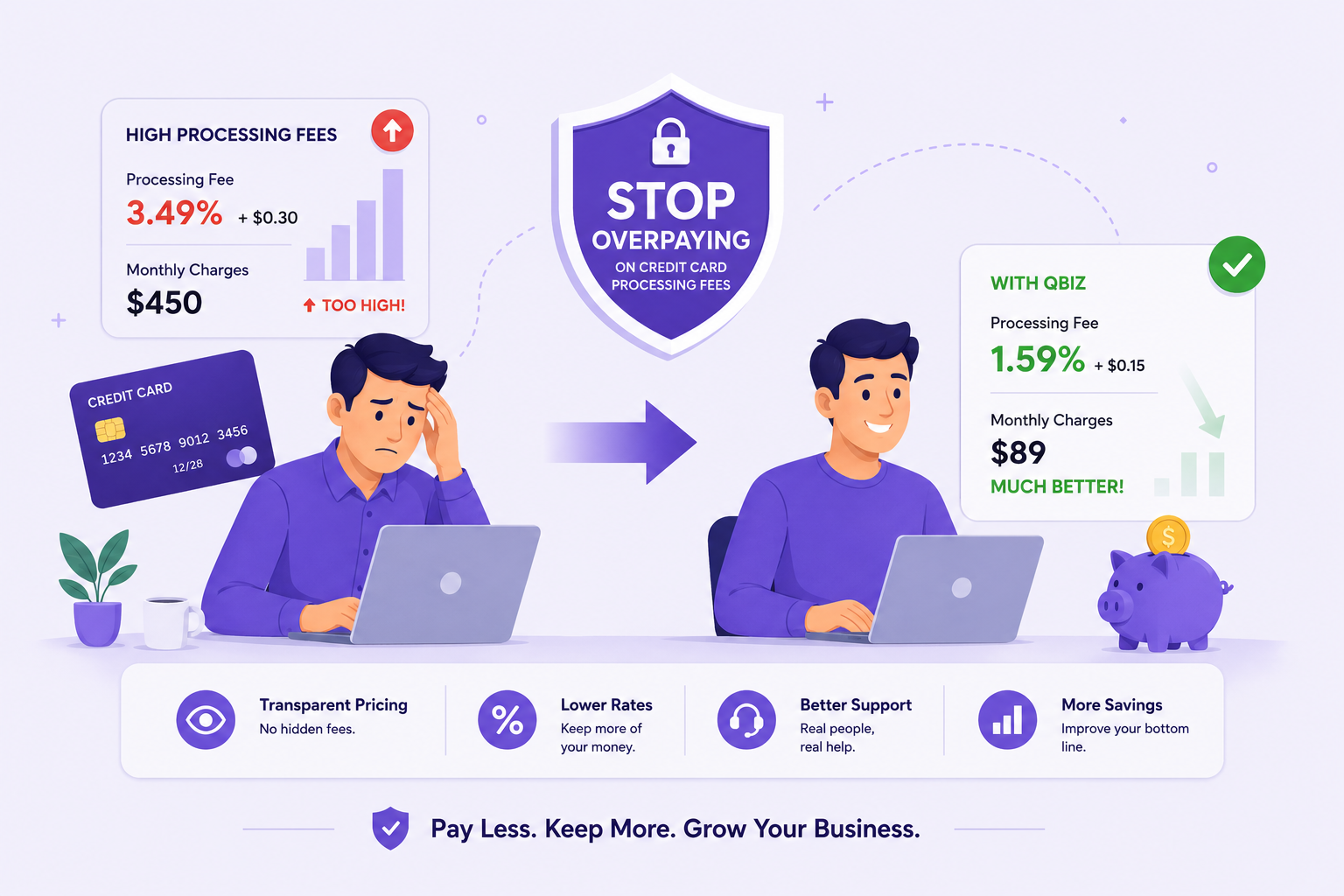
Pull up your last merchant statement and try to explain, out loud, what each line item actually means. Most owners get stuck by the third one. There's an interchange fee, an assessment fee, a markup, sometimes a PCI compliance fee, a statement fee, and a batch fee, and none of it is explained anywhere on the page.
That's usually not an accident. Processors tend to make more money when pricing is hard to follow. If you accept card payments and nobody has ever walked you through your actual rate, chances are you're overpaying by more than you realize.
So let's break it down. What are you actually paying for?
What's Really in Your Processing Fee
When a customer taps or swipes a card, three separate costs get bundled into one deduction from your payout.
The interchange fee is set by Visa, Mastercard, Discover, and Amex, and it goes to the customer's card-issuing bank. It doesn't matter who your processor is, this number stays fixed. Then there's the assessment fee, a smaller charge the card networks themselves take for the use of their systems. Also fixed, and the same no matter who processes your payments.
Tiered pricing sorts transactions into buckets, qualified, mid-qualified, non-qualified, each with its own rate. It sounds simple enough on paper, but the processor decides which bucket a transaction lands in, and non-qualified transactions often cost more. This model tends to favor the processor, not you.
Flat-rate pricing is simpler. One percentage plus a fixed fee, no matter the card used. It's easy to predict, which makes it a good fit for smaller businesses or ones without much transaction volume.
Interchange-plus usually offers the best value if your volume is steady or high. You pay the real interchange cost plus one small, clear markup on top, no guessing which bucket you fall into and nothing extra hidden underneath.
If your current provider has never told you which of these three you're actually on, take that as an answer in itself.
What Actually Lowers Your Costs
Start with a real rate analysis, not a sales pitch. That means an honest breakdown of your current effective rate against market rate, based on your real transaction data.
If you're on tiered pricing, ask about switching to interchange-plus. This is usually where the biggest savings show up.
Before signing anything new, ask what happens if you want to leave. A provider that doesn't charge a penalty for walking away is usually more confident in its own pricing.
Don't stop at the advertised rate either. "As low as 1.9%" can still mean higher monthly fees, gateway fees, or batch charges that only show up once your first statement arrives.
And once you do switch, don't just set it and forget it. Review your rate every year or so. Card network fees shift, your transaction mix changes, and most processors are counting on you never checking back in.
What to Look For in a Provider Right Now
Businesses take payment in more ways than they used to. A customer might pay in person, through an online checkout, or by tapping a payment link sent by text. Whatever provider you choose should support all three without forcing separate systems or separate contracts for each one.
Beyond that, a few things worth checking: pricing explained in plain language, not buried in fine print. Payouts you can actually predict, not a number that surprises you with every deposit. No long-term contract holding you in place. And ideally, a provider willing to show you a real rate analysis before you commit to anything.
That last point says more than it seems to. A company willing to show you your actual numbers upfront usually prices everything else the same way.
Where QBiz Fits Into This
QBiz Merchant Services was built around exactly this problem. You can accept cards in person, online, or by text, with pricing laid out in plain English and payouts you can see coming ahead of time. It starts with a free rate analysis, so you can see how QBiz compares to what you're paying now, and you can leave anytime with no early termination fee. Details are at myqbiz.ai/qbiz-merchant.
There's a bigger piece to this too. QBizis also a free AI Business Advisor for small business owners, and it connects to Stripe, Shopify, QuickBooks, and your ad accounts. Once your payment data is flowing through it, it's not just sitting on a statement anymore, it's feeding a live view of your cash flow and margins. Ask something like "how much did switching actually save me this month" and you'll get a plain answer instead of digging through a spreadsheet. Try it free at myqbiz.ai.
If you'd rather talk to a person first, that's fine too. You can sign up and go through your current statement with our team before deciding anything.
Common Questions
What's a good credit card processing rate for a small business?
Most small businesses in the U.S. fall somewhere between 1.5% and 3.5% per transaction, depending on card type and how the payment is taken. Anything meaningfully higher, especially on tiered pricing, is usually worth a second look.
What's the real difference between interchange-plus and flat-rate?
Interchange-plus passes through the actual network cost plus a small fixed markup, which tends to be cheaper if your volume is steady. Flat-rate is one simple percentage on everything, easier to predict but often more expensive over time.
Can I switch processors without paying a penalty?
It depends on your current contract. Many traditional processors charge an early termination fee, so it's worth checking your agreement before signing anywhere new, and choosing a provider going forward that doesn't lock you in.
Do all businesses pay the same fees?
No, not even close. It varies by industry, volume, average sale size, and whether cards are swiped, tapped, or keyed in manually. That's also why a generic "as low as" rate you see advertised rarely matches what a specific business ends up paying.
How do I find out if I'm overpaying?
Compare your effective rate, total fees divided by total volume, against current market rates for a business like yours. A free rate analysis from QBiz Merchant Services is the fastest way to get that number.
Can an AI Business Advisor help with more than just processing fees?
Yes. QBiz's AI Business Advisor connects to Stripe, Shopify, QuickBooks, and your ad accounts, so you can ask plain questions about revenue, cash flow, and profit too, not just fees. It's free for launch users, no credit card required to start.
Want to see how the AI Business Advisor ties payments, lending, and financial insight together? Read our post on QBiz's AI Business Bank launch, or browse more articles on the blog