How myQBiz.ai Combines Banking and Financing in One Platform
The story behind myQBiz.ai — built by Neema Mahdavian, a veteran of banking, finance, and venture investing and how its AI Advisor, Lending, and Merchant Services work together as one connected platform
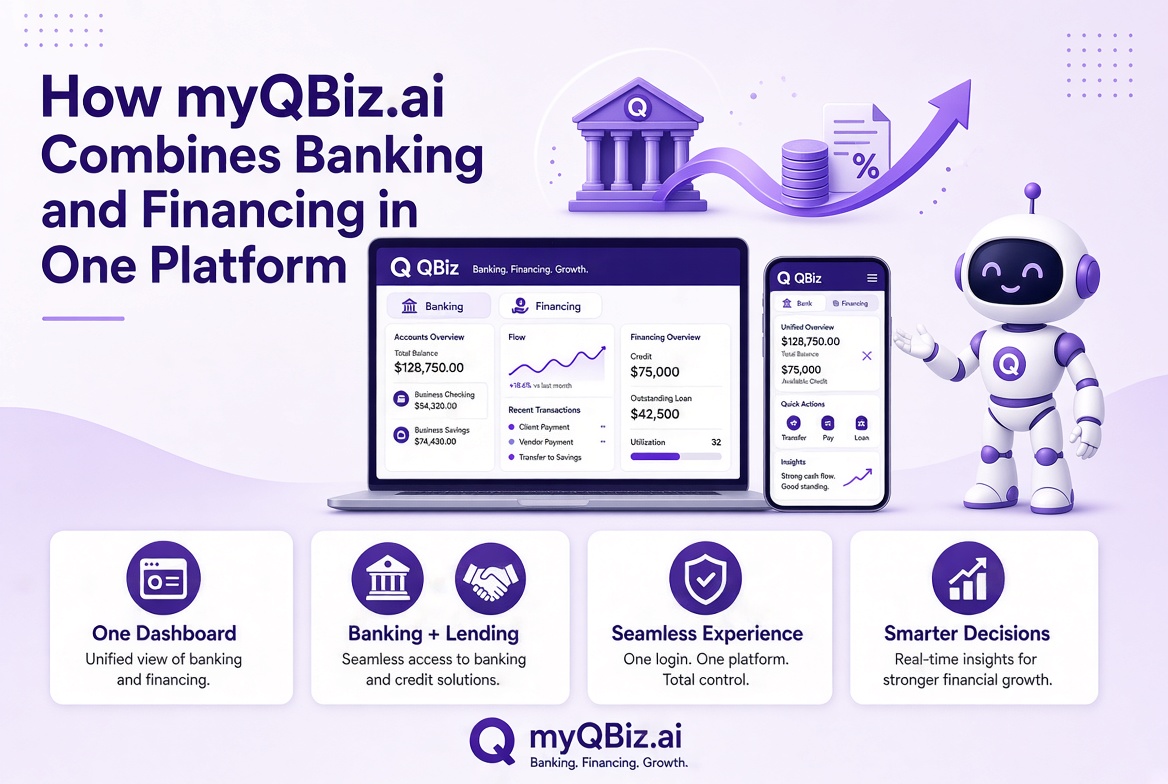
How myQBiz.ai Combines Banking and Financing in One Platform
Every small business ends up running its finances through the same collection of disconnected tools — a bank account, a payment processor, accounting software, and whatever spreadsheet holds it all together when nothing else does. Each piece works fine on its own. The trouble starts the moment you need the full picture, because none of those tools were ever built to talk to each other.
myQBiz.ai exists because of that specific gap. Not to add one more login to the pile, but to connect the pieces that already exist so a business owner can actually see what’s happening instead of reconstructing it every month by hand. To understand why it’s built the way it is, it helps to start with the person who built it.
The Career Behind the Platform
Neema Mahdavian reached a simple conclusion after more than two decades of founding, scaling, and exiting companies across finance, technology, and venture investing: entrepreneurs today have more financial products available to them than any previous generation, yet still lack consistent guidance on which decisions matter most and when to make them. That gap is what myQBiz.ai was built to close.
His own path started in banking, where he spent more than twenty years — learning, from the inside, how business finance actually works, where it breaks down, and why so many founders make the same avoidable mistakes. From there he built and sold a financial services company, and went on to found and exit additional businesses in marketing, coworking, and artificial intelligence.
Across all of it, Mahdavian says the lesson kept repeating itself: companies rarely fail because of one dramatic event. They fail because of small warning signs — a slipping margin, a client paying slower than usual, a cash cushion quietly thinning out — that go unnoticed for months until they can’t be ignored anymore.
That lesson now shapes two things he runs in parallel. One is Poseidon Ventures, the investment firm where he serves as founder and CEO, backing founders selectively rather than broadly. “I look for opportunities where I know I can add value,” Mahdavian has said of his approach. “Before I invest, I ask whether I can help that founder avoid a mistake I have already made myself. When the answer is yes, I stay close to the decisions that follow, and the business tends to hold its value long after the founder steps back.”
The other is myQBiz.ai itself — built on the same instinct, just productized: instead of one investor catching warning signs in a handful of portfolio companies, an AI system doing the same thing for any founder who connects their data.
The timing isn’t incidental either. A 2025 Goldman Sachs survey found that the large majority of small business owners who applied for a loan or line of credit in the past year struggled to secure affordable capital. In a lending environment that tight, the kind of financial clarity that used to sit behind a consultant’s invoice or a CFO’s salary stops being a nice-to-have and starts being close to a requirement for staying competitive.
Starting With Visibility, Not Just Banking
True to that philosophy, myQBiz.ai didn’t launch as a bank. It launched as a free AI Business Advisor — connecting to the tools a business already runs on, including Stripe, Shopify, QuickBooks, and Meta Ads, and reading uploaded documents like P&L statements to build a live, current picture of how the business is actually performing.
From there, owners ask plain-English questions — how is this month’s ad spend affecting margin, why did cash on hand drop after a slow week, is a given campaign actually paying for itself — and get answers pulled from their own numbers, not a generic template. The advisor also flags tightening cash flow before it turns into a missed payment or a stalled hire. It’s free for launch users, with no trial period and no card required to start.
“The kind of clarity QBiz delivers used to sit behind a consultant’s invoice or a CFO’s salary,” Mahdavian has said of the Advisor. “We built it to give every founder that same read on their business, in plain language. The most informed companies make the best decisions, and that has little to do with their size.”
Most financial products lead with a product first — an account, a card, a loan — and hope insight follows later. myQBiz.ai built the insight layer first, and everything since has been layered on top of that foundation rather than the other way around.
Why Lending Came Next
Once a business has real financial visibility, financing decisions change shape. A lender evaluating a business for the first time has to start from zero — pulling statements, verifying numbers, reconstructing a picture the Advisor already has sitting in front of it.
That’s the thinking behind myQBiz.ai Lending: multiple financing programs — including SBA loans, working capital loans, a revolving line of credit, and equipment financing — connected through one guided application rather than a separate process for each option. A human loan specialist is available throughout, so it isn’t a fully automated black box; it’s a faster version of a conversation a founder would otherwise be having from scratch with several different lenders.
Payments, Strategy Sessions, and What’s Still Ahead
More recently, the platform added Merchant Services, letting businesses accept payments and manage card processing from inside the same system already tracking the rest of their performance — so payment data stops sitting in a dashboard disconnected from everything else.
myQBiz.ai is also currently piloting Strategy Session, a set of guided voice sessions still in beta that let founders speak directly with the AI Advisor. A founder logs in, picks a focus for the week — growing revenue, improving cash flow, preparing for a loan application — and talks it through by phone, the way they might with a colleague, rather than typing questions into a chat window. New users can try a free five-minute session to see how it works.
What’s still ahead is a full AI Business Bank account, on the roadmap but not yet live. Today, the platform connects to an existing bank account through Plaid so the Advisor has visibility into a business’s full cash position — the banking layer, right now, is about seeing your money clearly, not yet about holding it. That’s a distinction worth being upfront about rather than blurring.
Why Build It This Way
The alternative — how most small businesses currently operate — is to treat banking, financing, and financial insight as three separate categories, handled by three separate vendors that never share information. That’s not necessarily wrong, just inefficient in an avoidable way: a business ends up re-explaining itself to every new tool, every new lender, every new advisor, instead of that context simply carrying forward.
The bet is that once a business’s financial data lives in one place, everything built on top of it — lending decisions, financial insight, faster answers to “why does this month look different” — gets meaningfully better, not just more convenient.
What This Looks Like Day to Day
In practice, the connected model shows up in small, specific ways:
• Asking the Advisor a direct question about cash flow instead of exporting reports from three platforms
• Applying for financing without starting from a blank page, because the numbers a lender needs are already visible
• Accepting a payment and seeing it immediately reflected in the same view used to track overall performance
• Getting flagged on a risk — a slow month, a downgraded transaction — before it becomes a bigger problem, instead of finding out weeks later in a statement
None of these individually sound dramatic. Together, they add up to a founder spending less time reconstructing their own numbers and more time acting on them.
Frequently Asked Questions
Who built myQBiz.ai? myQBiz.ai was built by Neema Mahdavian, Chairman and CEO, who spent more than two decades in banking, finance, and venture investing — including building and exiting an earlier financial services company — before founding the platform.
Is myQBiz.ai a bank? Not yet. A dedicated AI Business Bank account is on the roadmap. Today, it connects to a business’s existing bank account to give the Advisor visibility into cash flow, alongside live lending and merchant services.
Is the AI Business Advisor really free? Yes, for launch users, with no trial period and no credit card required to start.
How does the lending actually work? Through one guided application covering multiple financing programs, with a human loan specialist available if you want support along the way, rather than a fully automated process.
What is the Strategy Session feature? A beta feature where founders talk through their numbers by phone with the AI Advisor, choosing a weekly focus like revenue growth, cash flow, or loan preparation. New users can try a short session free.
What is Poseidon Ventures? Poseidon Ventures is the investment firm Mahdavian founded and leads as CEO, where he selectively backs founders in situations where his own operating experience can help them avoid mistakes he’s already made himself.
The Bigger Idea
The goal isn’t to be a faster bank or a cheaper lender in isolation — it’s to remove the gap between the financial tools a business already uses and the decisions that depend on them. Advisory first, lending built on top of it, payments connected to the same picture, and banking joining that system over time. Built by someone who spent two decades learning, the hard way, what founders actually need to see before it’s too late.