How Fast Can I Get Business Funding? (2026 Guide)
Business funding can take a few days or a few months. Here are realistic timelines by loan type, what causes delays, and how to speed things up.
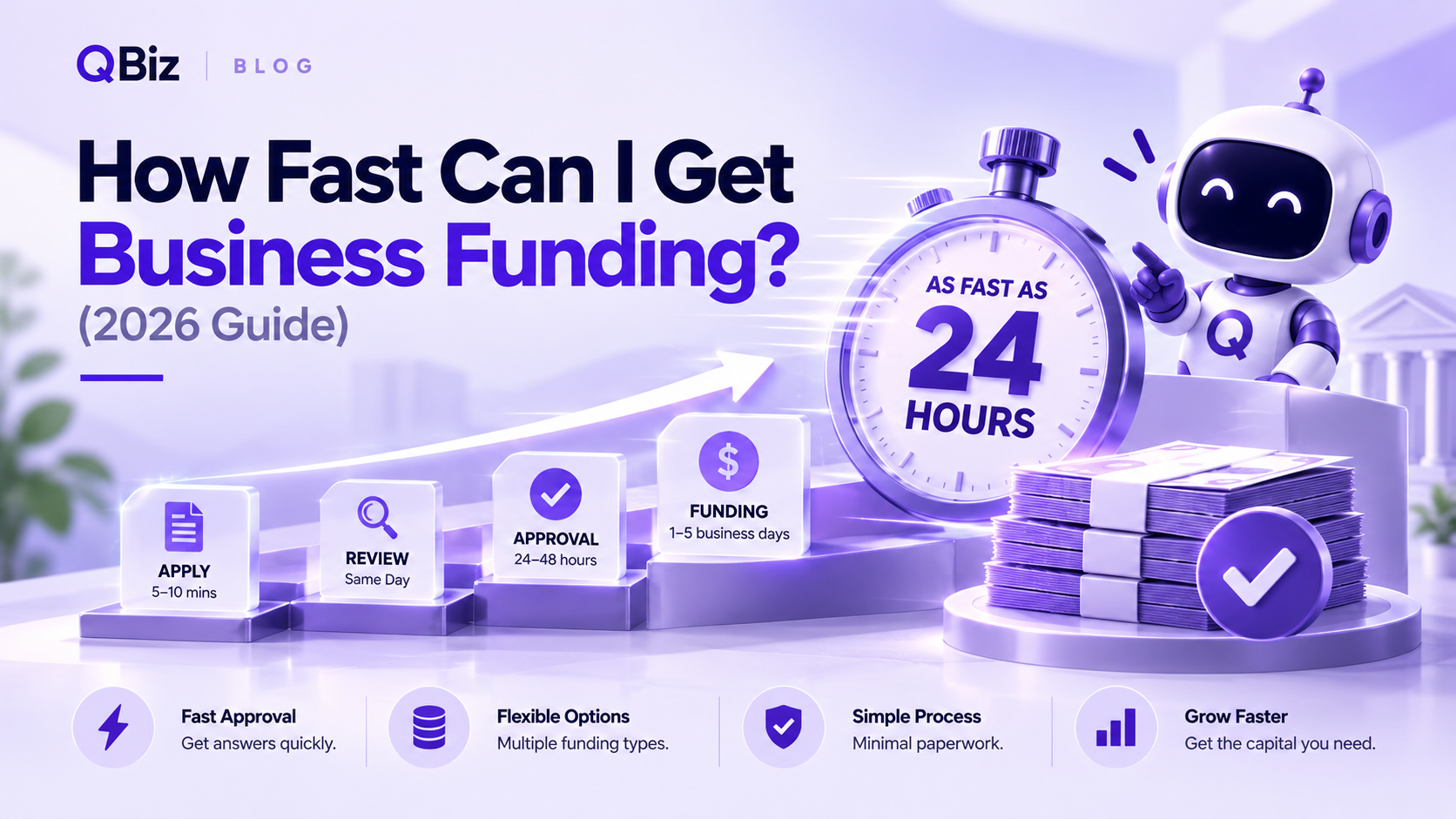
How Fast Can I Get Business Funding? (2026 Guide)
Short answer: business funding can take anywhere from a few days to a few months. Working capital loans, lines of credit, and invoice financing often move in days to a couple of weeks. SBA loans and commercial real estate loans usually take one to three months or more. The loan type, your documents, and your credit profile decide most of the timeline.
Every lender and every business is different, so treat the ranges below as a general guide. The good news is that a lot of the delay is in your control. This guide shows what drives the timeline and how to get business funding faster.
How Long Does Business Funding Take?
Different needs call for different products, and each one moves at its own pace. Here are the typical ranges:
Funding type Best for Typical timeline
Working capital loan Payroll, inventory, day-to-day costs Days to about 2 weeks
Revolving line of credit Flexible, repeat access to cash Days to a few weeks
Invoice (A/R) financing Cash tied up in unpaid invoices Days to about 2 weeks
Purchase order financing Paying suppliers on confirmed orders Days to a few weeks
Merchant cash advance Short-term cash against future sales Often within days
Equipment financing Machinery, vehicles, equipment About 1 to 4 weeks
SBA loans Longer terms, larger amounts Often 1 to 3 months
Owner-occupied Buying or refinancing your property Often 1 to 3 months
commercial real estate
Investment commercial Income-producing property Often 1 to 3 months
real estate
As a rule, the smaller and shorter the loan, the faster it moves. Bigger, longer-term loans get more review, so they take more time.
What Happens Between Applying and Getting Funded?
Almost every funding process follows the same five steps:
1. Eligibility check. You share basic business details and see which programs may fit.
2. Application. You complete the application for the program you pick and upload documents.
3. Underwriting. The lender reviews your revenue, cash flow, credit, and existing debt.
4. Offer. If approved, you get the terms: amount, cost, and repayment schedule.
5. Closing and funding. You sign, and the money goes to your business account.
Underwriting is where most of the waiting happens. It’s also the step you can influence the most.
What Slows Business Funding Down?
Delays rarely come from the lender alone. These are the usual causes:
• Missing or outdated documents. Every back-and-forth request adds days.
• Numbers that don’t match. Bank statements, tax returns, and financial statements that disagree trigger extra questions.
• The wrong product. A loan that doesn’t fit your business gets declined or restructured.
• Unclear use of funds. Lenders want to know exactly what the money is for.
• Messy records. Mixed personal and business spending makes your finances harder to verify.
• Bigger amounts and longer terms. More money means more review.
How to Get Business Funding Faster
You can’t control the lender’s process, but you can remove most of the friction on your side.
1. Know what you need and why. Write one sentence with the amount, the purpose, and how you’ll repay it.
2. Gather your documents first. A typical starting list:
• Recent business bank statements
• A profit and loss statement and balance sheet
• Business and personal tax returns
• A list of current debts
• Business registration details and ID
Requirements differ by program, so use this as a starting point.
3. Make your numbers line up. Reconcile your bank, accounting, and sales records before you apply.
4. Check your cash flow. Lenders want proof that you can comfortably cover repayments. If yours feels tight, start with our guide on how to track cash flow without hiring a CFO.
5. Pick the right product. A short-term cash gap and a ten-year property purchase need very different tools. If you’re still comparing, our guide to small business financing options walks through them.
6. Use one application where you can. Applying to several lenders separately means repeating the same paperwork each time.
7. Ask for help early. A specialist can spot problems in your application before they cost you time.
Is Faster Always Better?
Not always. The fastest option is rarely the cheapest, so look past speed before you accept an offer. Compare:
• Total cost, not just the headline rate. Ask for the full repayment amount.
• Repayment schedule. Daily or weekly payments hit cash flow differently than monthly ones.
• Fees and prepayment terms.
• How repayment works. A merchant cash advance, for example, isn’t a traditional loan. It’s an advance on future sales, repaid as a share of revenue, and it can cost more than other options.
If you don’t need the money this week, a slower product with a lower cost may be the better fit. A business line of credit gives you flexible access to cash, while an SBA loan offers longer repayment terms but takes longer to arrange. Our step-by-step guide on how to apply for an SBA loan covers that process.
Which Funding Option Fits Your Situation?
If you need…
Consider
Speed
Cash for payroll or inventory soon
Working capital loan or line of credit
Faster
Money for a vehicle or machine
Equipment financing
Moderate
Cash from unpaid customer invoices
Invoice financing
Faster
Funds for a confirmed big order
Purchase order financing
Faster
A large loan with long repayment
SBA loan
Slower
To buy or refinance property
Commercial real estate loan
Slower
Running a newer business? Your options may be narrower, but they exist. See our guide to SBA loans for new businesses for what’s possible without a long history.
Get Matched Faster with myqbiz.ai Lending
Instead of applying to lender after lender, myQBiz.ai Lending puts nine loan programs into one guided application. Programs range from $10K to $100M, depending on the program.
Here’s how it works:
• Check eligibility in about 2 minutes. It uses a soft credit inquiry, so your credit score isn’t affected. A hard inquiry only happens later, if you choose a program and complete a full application.
• See every program your business may fit. From SBA loans to lines of credit, equipment financing, and invoice financing.
• Talk to a human loan specialist. They walk through your numbers, explain each program, and stay with you through the application.
You can also use the free AI Business Advisor, which connects to Stripe, Shopify, and QuickBooks. It helps you understand your revenue, cash flow, and profitability before you apply, so your application is easier to prepare.
Key Takeaways
• Funding can take days or months, depending on the loan type.
• Smaller, shorter-term products usually move faster than SBA and real estate loans.
• Most delays come from missing documents, mismatched numbers, and choosing the wrong product.
• Preparing your documents and checking your cash flow first is the best way to speed things up.
• The fastest option isn’t always the cheapest, so compare total cost before you accept.
Ready to see what you qualify for and how fast you could be funded? Check your eligibility with myQBiz.ai Lending. It takes about two minutes, with no impact on your credit score, and a human loan specialist is there whenever you want help.
Frequently Asked Questions
How fast can I get business funding? It depends on the type. Working capital loans, lines of credit, and invoice financing can move in days to a couple of weeks. SBA and commercial real estate loans often take one to three months or more.
What is the fastest way to get a business loan? Prepare your documents in advance, choose a product that fits your need, and keep your financial records consistent. Short-term products generally move faster than long-term ones.
How long does it take to get an SBA loan? SBA loans take longer than most options because of extra review and paperwork. Many take one to three months or more.
What documents do I need to get business funding? Commonly requested documents include business bank statements, a profit and loss statement, a balance sheet, tax returns, a list of current debts, and business registration details. Requirements vary by program.
Will checking my eligibility affect my credit score? Not with myQBiz.ai Lending. Checking eligibility uses a soft credit inquiry, which doesn’t affect your score. A hard inquiry only happens if you choose a program and complete a full application.
Can a new business get funding quickly? Sometimes. New businesses may have fewer options, and lenders may look more closely at revenue, personal credit, or collateral.
Does faster funding cost more? It can. Some fast products carry higher costs, so compare the total repayment amount, fees, and repayment schedule, not just the speed.